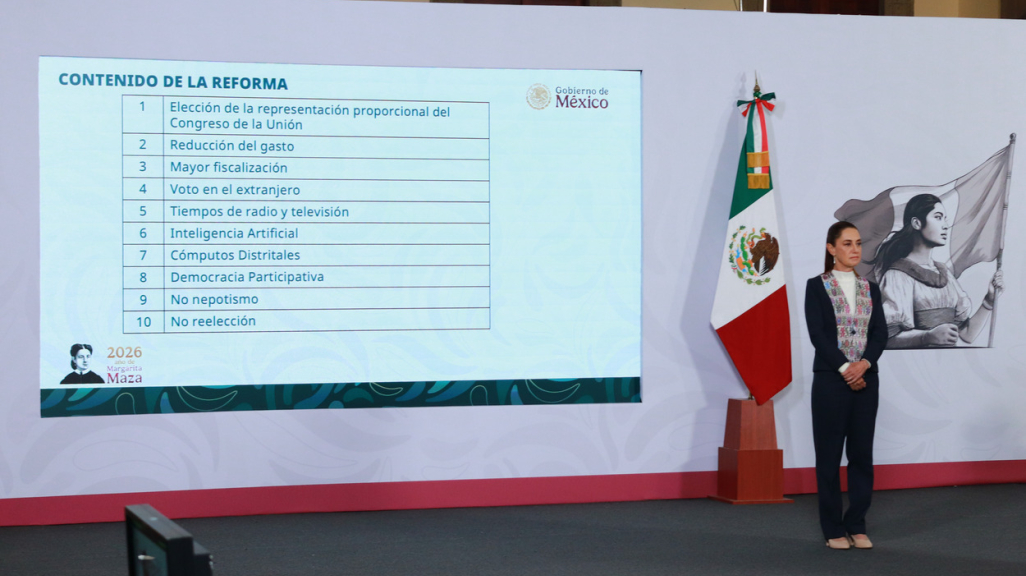
Mexican President Claudia Sheinbaum presents her electoral reform. (AP)

Mexican President Claudia Sheinbaum presents her electoral reform on February 25. (AP)

After Sheinbaum's Electoral Reform Stalls, What Comes Next?

By Chase Harrison

The Mexican president’s proposed constitutional changes were voted down by parties within her own coalition. What’s her Plan B?

At the tail end of his presidency, Andrés Manuel López Obrador proposed a 20-point reform plan to fundamentally reshape the Mexican state.After, López Obrador (2018–2024) and his successor and political mentee Claudia Sheinbaum (2024-present) worked through that list.

But one aspect of the agenda, a reform to the country’s electoral system, has thus far remained elusive. While in office, López Obrador proposed steps focused on the National Electoral Institute (INE) that failed to pass Congress in late 2022. A revised version, known as Plan B, made it through Congress in 2023, only to be largely invalidated by the Supreme Court

The baton then passed to Sheinbaum, who included an electoral reform in the 100 promises she made at the start of her term. After delays, Sheinbaum finally submitted her version to the Chamber of Deputies on March 4 with changes that included reshaping the composition of Congress, cost-cutting and efficiency measures, and new regulations that ran popular with the Mexican public. “On paper, it sounds like it enhances democracy,” explained Yussef Farid of the risk consultancy EMPRA. But the legislation’s critics said it concentrated power in Sheinbaum’s ruling Morena and would bring Mexico one step closer to the days of single-party rule.

On March 10, on its inaugural day of debate in the Chamber of Deputies, legislators voted it down with 259 votes in favor, 234 against—71 votes short of the two-thirds majority needed to pass. Not only did the opposition reject it, but so too did Morena’s coalition partners, the Green Party of Mexico (PVEM) and the Workers' Party (PT), marking an unprecedented legislative fracture for the alliance. “It is very much one of the first failures for Sheinbaum,” said legislative expert Georgina de la Fuente of Strategia, “in terms of what she proposed in her campaign and what her predecessor set out.”

A day after, the defeat, Sheinbaum said she had anticipated the initiative would fail but said she had fulfilled her promise “to submit a reform the people asked for.” She then began to articulate her vision for a Plan B, which is expected to be submitted to Congress as soon as March 16.

What was proposed?

Sheinbaum’s electoral reform, divided into 10 points, included the following constitutional changes:

The defeat of the reform

Even before the reform was presented, the opposition National Action Party (PAN), Institutional Revolutionary Party (PRI), and the Citizens’ Movement (MC) came out against it.

Sheinbaum's Morena party has a majority in Congress, but, as a constitutional reform, the votes of its junior coalition partners, the PVEM and the PT, were needed to pass the two-thirds threshold. They rejected it.

Why? Under the proposed changes to the proportional representative system, both would potentially lose seats, and public funding cuts would hamper their activities. Alberto Anaya, leader of the leftist PT, argued the reform would destroy Mexico’s party system

The proposal even caused “a few sparks of opposition even within Morena,” says de la Fuente, with three legislators from the party voting against it.

What comes next?

Sheinbaum articulated a vision of what her Plan B will look like in her March 12 press conference. Here, she focused on the curtailing of budgets and seats in local congresses and municipalities, as well as cuts in the Senate and strengthening the popular consultation mechanism. She said that she may use this electoral tool to push for national votes on aspects of the electoral reform or enact a referendum on her presidency in her third or fourth year. 

More details will be articulated in Plan B materials submitted next week. Given Morena’s 2024 judicial reform, which led to the election of a Supreme Court more closely allied to the government, the top court would be less likely to serve as an obstacle to a reform—constitutional or not— that wins congressional approval.

Farid says that, instead of seeking a constitutional reform, which requires two-thirds support, Sheinbaum could instead seek to pass laws that would only need majorities in each house. “The caveat,” says Farid, “is that, as they are modifying it without putting it in the constitution, they could be reversed more easily.” If Sheinbaum chooses this route, he continues, she may attempt to pass more than just what’s in her electoral reform, including expanded reforms to the INE. Such a move would build on López Obrador’s historical animosity toward the agency, which he had attempted to restructure.

Despite this, while Sheinbaum's proposal substantially trimmed the agency’s budget, de la Fuente said the president could have gone further. “I was quite surprised because the president had been very vocal about her wanting elections to be cheaper and that the structures of the electoral institutions were too expensive,” said de la Fuente. She explains that compared with other countries’ electoral agencies, the INE is more costly but it’s because it has a larger remit of responsibilities than comparable institutions. Now, de la Fuente expects a part of the Plan B to target the INE, either slashing its budget or narrowing its domain.

Looking to the midterms

In June 2027, Mexicans will vote in a midterm in which they will renew all seats in the Chamber of Deputies and vote for 17 governorships. For any of these electoral reforms to be in place in time for that round, they must be passed 90 days ahead of the start of the electoral season in September.

Farid contends that the reform’s failure spells other challenges for Sheinbaum heading into that election. “It will confirm a sense that she doesn’t have control over the party,” he says, adding it could weaken her ability to exert her preferences on midterm candidate nominations. Morena officials have argued that the coalition will stick together, regardless of the reform’s rejection. However, Farid notes, “Behind the scenes, some sources say the relation is strained. It may not be broken, but it’s not the same as it was in 2024.”

But de la Fuente argues that resistance to the electoral reform be a political boon for the president’s government. In a country where trust in Congress runs low, Sheinbaum’s reform measures to slash funds for parties and expand direct election of legislators had over 80 percent approval per a February Enkoll poll.

“It benefits them in terms of saying that they’ve been trying to cut privileges, but they are still being blocked by political elites,” she said.

Related

Explore