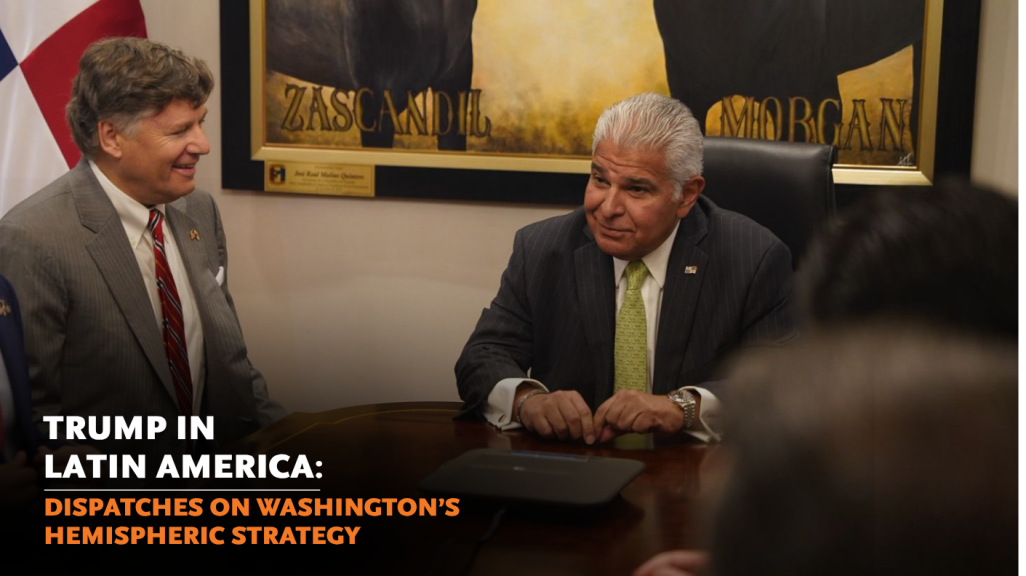
(L-R) U.S. Deputy Secretary of State Christopher Landau meets with Panamanian President José Raúl Mulino. (U.S. Ambassador to Panama)

(L-R) U.S. Deputy Secretary of State Christopher Landau meets with Panamanian President José Raúl Mulino. (U.S. Ambassador to Panama)

Trump in Latin America: Trump Gains an Ally in Colombia; OAS Meets in Panama

By Chase Harrison and Khalea Robertson

June 18-24: Plus, Cuba introduces market reforms and a Venezuelan opposition figure reemerges.

Welcome back to our weekly dispatch of stories on the U.S. role in Latin America. Follow us each week and see previous roundups at as-coa.org/dispatches, or sign up to receive them via LinkedIn

Here’s what to know this week: 

  • Colombia’s Abelardo de la Espriella plans to join Shield of the Americas upon inauguration.
  • OAS hosts assembly amid Trump administration scrutiny and U.S. personnel exodus.
  • Cuba approves economic overhaul measures, faces new U.S. sanctions.
  • A Venezuelan opposition lawmaker reemerges with U.S. backing in democracy talks with the interim government.
De la Espriella signals Colombia will join Shield

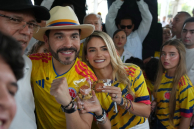
A day after Colombia’s June 21 runoff vote, U.S. President Donald Trump congratulated Abelardo de la Espriella on his victory, saying on Truth Social: “I look forward to working together to build a powerful relationship between Colombia and the United States of America, which will bring new levels of Greatness for both of our Countries!” Trump endorsed de la Espirella before both the first and second rounds of Colombia’s presidential votes. De la Espriella, a U.S. citizen who lived in Miami before starting his campaign, has proposed enhanced bilateral collaboration and on Tuesday reemphasized that, when he takes office on August 7, Colombia will join the Shield of the Americas, a security initiative launched by Trump in March and made up of ideologically aligned governments in the hemisphere. 

Several other members of the Trump administration congratulated de la Espriella on election night, including Secretary of State Marco Rubio. Shortly before the election, Rubio defended the deportation of Franklin Humberto Coral Garrido, a Colombian immigrant living the United States, who had criticized de la Espriella online. Rubio wrote that Coral Garrido’s commentary “undermines U.S. foreign policy interests in Colombia’s democratic processes and signals that foreign nationals may use U.S. platforms to conduct politically motivated disinformation campaigns and litigation targeting foreign democratic actors without consequence.” 

Trump shared a Newsmax article that credits him with the string of victories of right-wing leaders in Latin America since he returned to office. The Wall Street Journal profiled those Trump-aligned leaders

Who among Latin America’s presidents is a Trump buddy? Mexico’s Te lo cuento maps out which ones are amigazos... and which ones aren’t so much. 

At OAS forum, an exodus of U.S. diplomats

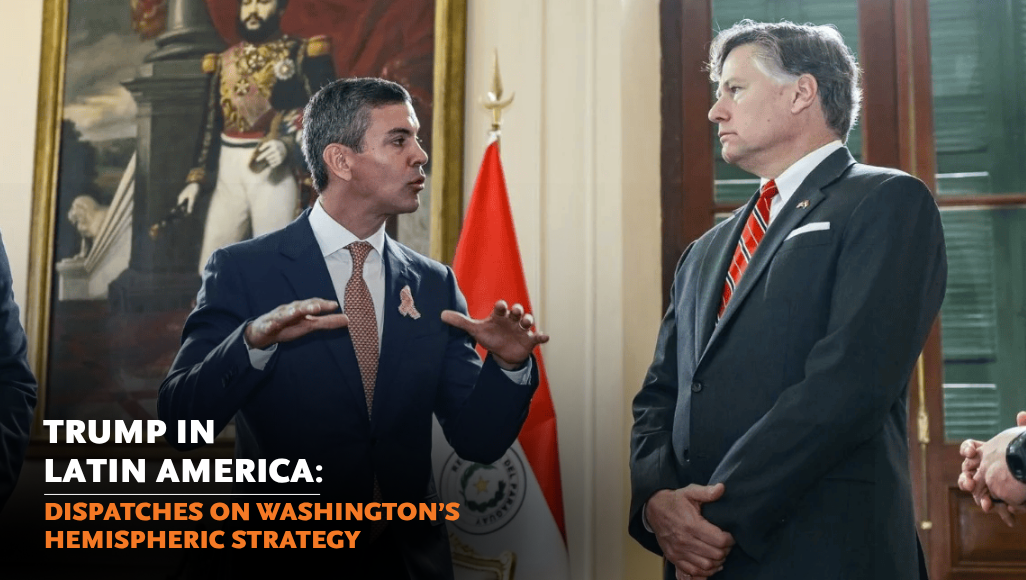
From June 22 to 25, Panama City hosts the Organization of American States’ 56th General Assembly, organized under the theme, “Firm Multilateralism in Defense of Democracy, Hemispheric Security, and Stability in the Member States.” Several regional presidents and high-level diplomats have been in attendance, including U.S. Deputy Secretary of State Christopher Landau, who met with Panamanian President José Raul Mulino

The assembly follows U.S. pressures on the agency. In May, an internal White House memorandum showed that the Trump administration was questioning the management of OAS head Albert Ramdin and considering appointing an independent investigator. In June, the U.S. revoked the visa of Xaviera Jessurun, Ramdin’s chief of staff, due to alleged corruption. Simultaneously, Reuters reports that much of Washington’s senior OAS team was either fired or resigned after personal and policy confrontations with U.S. Ambassador to the OAS Leandro Rizzuto Jr., who is acting on a Trump administration goal of shifting focus from democracy and human rights toward economic matters.

Still, Landau’s remarks in Panama reflected signs of cooperation, with the deputy secretary saying: “the United States believes in the potential of this organization ...We want this organization to be part of the solution.” 

More sanctions on Cuba after major economic reform package

Washington continues to pressure Havana and, on June 23, Rubio added four more Cuban state companies to the list of sanctioned entities, along with ex-President Raúl Castro’s daughter-in-law.  Rubio linked three of the companies to GAESA, Cuba’s military-run conglomerate, and took to X to accuse them of stealing “the island’s few resources, diverting them for repression, anti-American subversion and spying instead of schools, power plants, and basic necessities for the Cuban people.” He warned that foreign individuals and companies found to be working with GAESA risk attracting sanctions.

The new sanctions came five days after the Cuban regime announced a raft of reforms aimed at opening up the island’s beleaguered economy. The Cuban parliament approved 176 measures on June 18 that include a rollback of universal state subsidies, the removal of a 100-employee cap on private businesses, and permission for private banks and financial institutions to operate on the island. Foreign investors will no longer need to enter partnerships with the government, instead allowing them to invest directly in the private sector, including in energy; A lack of fuel continues to afflict the island’s population and production

While addressing the National Assembly, Cuban leader Miguel Díaz-Canel denied that the reforms were a reaction to negotiations with the United States. In a televised meeting with Communist Party leaders the day before, he recognized that the current crisis was in part due to “slowness, bureaucracy, and norms that hinder those who want to produce.” CNN en Español coverage of the reforms includes State Department comments labeling the measures a “superficial smoke signal” and emphasizing, “President Trump will continue applying pressure to push for much more substantial political and economic reforms that will make Cuba a place ready for investment.”

Headlines of the week

Following Cuba’s market-opening measures, Mexican President Claudia Sheinbaum said on June 22 she hoped to soon restart oil shipments to the island via private firms

On June 23, the U.S. Supreme Court ruled in favor of ExxonMobil in a case that could pave the way for U.S. companies to make claims on properties seized by Cuba’s government following the 1959 Revolution. Disclaimer: Exxon Mobil Corporation is a Council of the Americas member.

Bloomberg profiles Rosa María Payá, a Cuban pro-democracy activist working with the Trump administration to plan for a possible democratic transition on the Communist-run island. Payá is the daughter of Cuban dissident leader Oswaldo Payá, slain in a 2012 car accident caused by the Cuban government

The State Department expressed support for a June 18 meeting between Dinorah Figuera, president of Venezuela’s 2015 National Assembly, and the Assembly’s current President Jorge Rodríguez "to discuss an agenda that will serve as the roadmap for a political dialogue on a democratic transition.” Figuera, who returned to Venezuela after eight years in exile, also met with John Barrett, the lead U.S. diplomat in Caracas, as well as other Venezuelan opposition leaders, and said she was traveling to Miami on June 19 for other meetings

In the meantime, the Financial Times reports that the Venezuelan government is set to disclose a larger-than-expected debt burden of $240 billion as it makes steps toward a major economic restructuring. 

Related

Explore