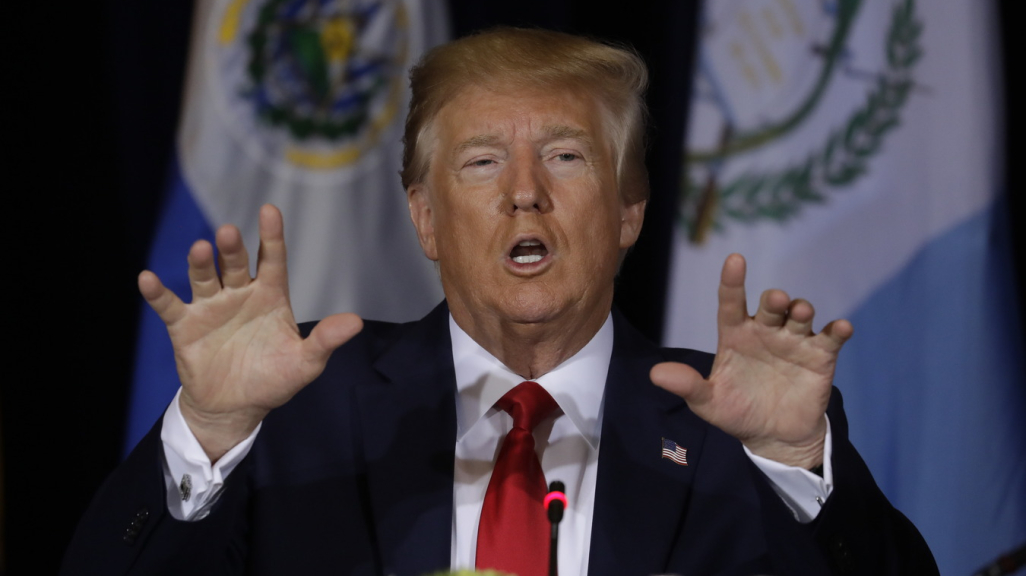
U.S. President Donald Trump. (AP)

U.S. President Donald Trump. (AP)

One Year in, Trump's Impact on Latin America and What's Next

By Carin Zissis and Chase Harrison

From tariff turbulence to a capture in Caracas, Trump 2.0 sharpened Washington's focus on the region. What were major 2025 events? What’s on the horizon?

January 20 marks the one-year anniversary of Trump 2.0, and what a year it’s been. The start of the second administration of U.S. President Donald Trump was marked by a dramatic shift in Washington’s foreign policy and, whether you call it America First or the Donroe Doctrine, it’s arguable that no region has felt the impact more than the Americas.

One only need look at events that bookmarked this timespan for proof; Trump started the year with a threat to apply 25 percent tariffs on imports from Mexico and Canada—the top two U.S. trade partners—and closed it with an operation to capture Venezuela’s Nicolás Maduro. Marked by a preference for bilateral deals over multilateral negotiations along with a revival of U.S. involvement in Latin America and the Caribbean, the administration has overseen major changes on immigration, trade, and security that have redrawn regional ties to, among other goals, counter China’s hemispheric footprint.

What are some of the major policy steps that affected the Americas in the first year of the second Trump administration, and what will be the issues to watch in in the second? Here’s a look.
The big events of 2025

Rattling North American trade ties. While on the campaign trail in October 2024, Trump told a room full of executives in Chicago that “the most beautiful word in the dictionary is ‘tariff.’” That sentiment came to bear swiftly on his inauguration day, when he signed a memorandum telling his cabinet to review “unlawful migration and fentanyl flows” from Canada, Mexico, and China and consider trade and security responses.

On February 1, Trump declared 10 percent tariffs on imports from China but went even higher—25 percent—on neighboring Canada and Mexico. That triggered a cycle of tariff threats, negotiations, and postponements, which saw Mexican President Claudia Sheinbaum described as a “Trump whisperer” for winning tariff delays. Meanwhile Canada held an April election as frustration grew over how to respond to the U.S. president. Throughout the year, Trump enacted higher tariffs on his North American neighbors, including on key products like cars, trucks, steel, and aluminum. But goods compliant with the U.S.-Mexico-Canada Agreement (USMCA) were considered exempt.

Liberation Day globalizes tariffs. Come April 2, a day Trump dubbed “Liberation Day,” the president unveiled plans to levy tariffs on trade partners around the world. Most countries in the Americas faced a baseline rate of 10 percent while the White House threatened select countries with higher levels. Trump then delayed tariffs above the baseline, eventually implementing them on August 1

But no country in the region faced a higher rate than Brazil. In July, Trump posted a letter on Truth Social slapping 50 percent tariffs on exports from the South American giant in protest of the prosecution of conservative ex-President Jair Bolsonaro. After encounters with Brazilian President Luiz Inácio Lula da Silva like a surprise hug backstage at the UN and a meeting at ASEAN, Trump dropped the tariffs on a host of critical Brazilian products, like cocoa and coffee beans, in November.

Some carrots among sticks. The Trump approach led countries to seek bilateral deals with Washington. On November 13, Washington announced sector-specific trade frameworks for four Latin American countries: Argentina, Ecuador, El Salvador, and Guatemala.

And what about that Argentine bailout? The warm relationship between Trump and his biggest Latin American ally, Argentine President Javier Milei, was showcased when the White House announced, just days ahead of Argentina’s October midterm vote, that it would provide a loan of up to $20 billion to stabilize the country’s currency markets. Milei’s political force scored big in that election.

Trump would go on to weigh in on another election in Latin America, backing conservative presidential candidate Nasry “Tito” Asfura in Honduras while simultaneously pardoning the country’s ex-President Juan Orlando Hernández from his 45-year sentence for narcotrafficking. After a tight election, Asfura was proclaimed the victor, despite an ongoing dispute over results.

Migration goes net negative. In 2025, the United States experienced negative net migration for the first time in over 50 years. With the Trump administration actively discouraging immigration and narrowing legal pathways, apprehensions at the border dropped 87 percent between October 2024 and October 2025. The White House expanded deportation efforts, scaling up the Immigration and Customs Enforcement (ICE) budget by 400 percent. ICE reported a record 600,000 deportations by December. 

While U.S. authorities sent most deportees to their home countries, an estimated 8,000 people were flown to others where the Trump administration made or expanded third-country deals, such as Belize, Costa Rica, El Salvador, Guatemala, Honduras, Mexico, Panama, and Paraguay. In some cases, political pressure led countries to accept migrants; Panama took in 300 foreign deportees after U.S. threats to retake the country’s Canal. El Salvador, meanwhile, reportedly received $6 million to accept more than 200 Venezuelan nationals in March at its notorious megaprison. 

The Trump administration also curtailed programs like Temporary Protected Status, humanitarian parole, and the asylum system, many of which apply to large numbers of Haitian, Honduran, and Venezuelan migrants.

A drug war of words and munitions. The war on drugs grew as a central issue in the Trump administration’s first year, and it named 15 new groups in Latin America and the Caribbean as Foreign Terrorist Organization, or FTOs. The Trump administration also accused Mexico of being run by drug cartels and decertified Colombia as a counternarcotics partner

By the end of the year, Trump designated fentanyl a “weapon of mass destruction.” 

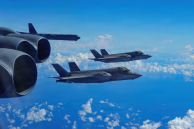
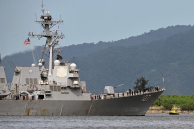
Under the justification of battling counternarcotics, the U.S. military turned to the South Caribbean in the last quarter of the year, where it assembled the largest build-up of personnel and equipment in the region since the Cuban Missile Crisis. Concurrently, the military struck alleged drug boats in Latin American waters, killing at least 115 people

What issues will shape 2026?

A strike before dawn. If tariff threats defined the White House’s 2025 hemispheric policy, an early morning raid in Caracas just after the New Year’s holiday will shape the year to come. On January 3, a U.S. operation involving 200 troops and 150 aircrafts captured Nicolás Maduro and First Lady Cilia Flores, flying them to New York to face narcoterrorism charges.

Later that morning, Trump said his government would be working with Delcy Rodríguez, Maduro’s vice president, who was sworn in to the top spot that weekend. He then appeared to dismiss Nobel Peace Prize-winning opposition leader María Corina Machado as “a nice woman” who “doesn’t have the support or the respect within the country.” In 2024, Machado endorsed Edmundo González Urrutia, widely recognized as the winning candidate in Venezuela's presidential vote, after the regime barred her from running.

Questions abound about what will come next. Will the installation of Rodríguez leave the architecture of Maduro’s regime intact? What is the outlook for Venezuela’s energy sector after U.S. oil executives expressed skepticism about investing? What does the Venezuelan operation mean for the rest of the region?

Ripple effects. The January 3 events drew responses from Latin American leaders that ranged from celebration to condemnation, but it also sparked speculation about where the White House might next apply pressure and how to react.

Some leaders already have. After months of warring social media posts between Trump and Colombia’s leftist President Gustavo Petro, the tone shifted from combative to cordial. In the days following the Caracas raid, Trump went from, on January 5, calling Petro a “sick man who likes making cocaine” to revealing they spoke two days later on the phone—a conversation he called “a great honor”—and that the Colombian leader would visit the White House in early February. Nicaragua, meanwhile, announced the release of some political prisoners.

On the other hand, when Trump warned that, with the flow of cash and oil cut off, Havana should “make a deal, before it is too late,” Cuban President Miguel Díaz-Canel replied: “No one tells us what to do.” Regardless of what comes next, Cuba remains in economic turmoil, with an estimated 89 percent of the population living in extreme poverty. 

Mexican matters. Trump has repeatedly floated the idea of U.S. strikes on drug cartels on Mexican soil since at least his first term, but the idea hit differently when he said “something is going to have to be done about Mexico” during a FOX News interview hours after the Venezuela raid. Sheinbaum and Trump had a phone call on January 12 that the Mexican president described as “very good” in which she said she told him strikes on Mexican soil are “unnecessary.”

Still, with a July review of USMCA, observers say Washington could leverage the trade talks to gain more security concessions from Mexico. The fact is not lost on the Sheinbaum government, which has trumpeted kingpin extraditions and fentanyl seizures as signs it’s cooperating, drawing praise from Secretary of State Marco Rubio. But uncertainty about the deal’s fate continues, with Trump calling the pact, inked during his first term, “irrelevant” on January 13. This comes as the two countries, along with Canada, prepare to host the World Cup—and with more countries in the hemisphere participating in the tournament than ever before.

Forward view. Events that could disrupt hemispheric relations—from the USMCA review to an impending Supreme Court ruling on Trump’s trade policy—pepper the calendar in 2026. Already, the Trump administration suspension of visa processing or 75 countries included eight in Latin America. After Maduro’s capture, Trump declared: “American dominance in the Western Hemisphere will never be questioned again.” Whatever the future holds, trade, immigration, and security will be top regional issues in 2026.

Related

Explore