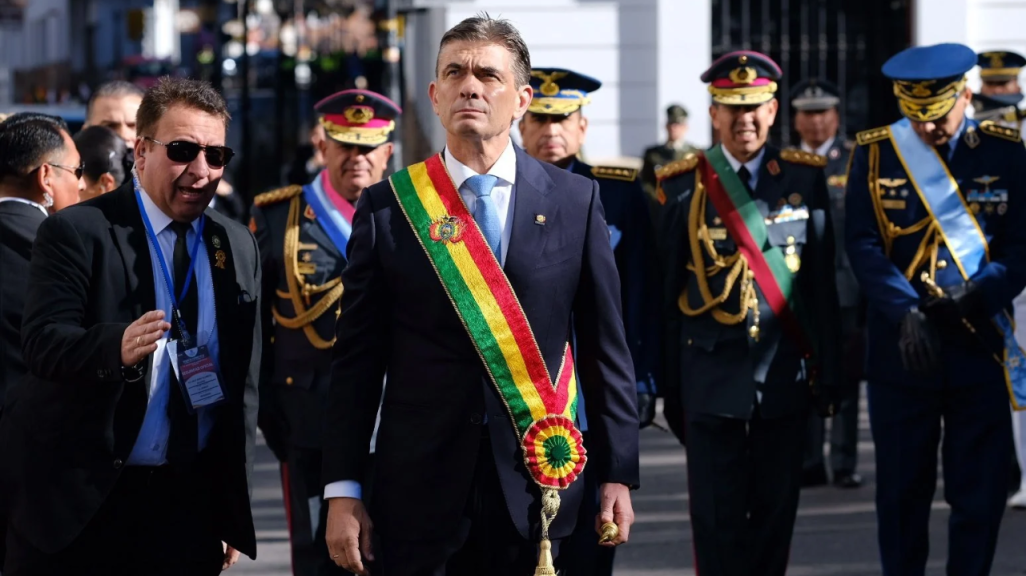
Bolivia's Rodrigo Paz in ceremonial sash

Bolivian President Rodrigo Paz. (X account of the President's Office)

One Year in, Rodrigo Paz Battles to Stabilize Bolivia's Fuel and Fiscal Woes

By Khalea Robertson

The president, weathering social pushback on his government’s efforts to liberalize energy and mining sectors, has turned to U.S. and IMF support.

Bolivia’s President Rodrigo Paz has battled his way through a rough first year in office, and the challenges keep piling on. Since his November 2025 inauguration, Paz has had a public falling out with his vice president, withstood roiling protests, and undergone scrutiny for ties to a former political advisor facing an attempted murder charge. On top of all that, his government must ready for the impacts of a Super El Niño weather event. Just 21 percent of Bolivians approve of the president’s performance, per a September poll from Ipsos.  

But he didn’t inherit an easy scenario. “We declare an economic, financial, energy, and social crisis,” announced Paz in a national address in December 2025, outlining his country’s persistent woes of high inflation; food, fuel, and dollar shortages; and a fiscal deficit equal to 10 percent of Bolivia’s GDP. Paz had just ended two decades of leftist governments with promises of “capitalism for all” on his campaign route to victory, pledging to stabilize Bolivia’s ailing economy without eliminating the state’s social safety net.

So how are his plans to cut back on spending, boost revenue, and open Bolivia back up to the global market and financial systems going? 

Natural gas and critical minerals underpin revenue hopes

The IMF estimates that Bolivia's economy will contract by 3 percent in 2026, marking its third consecutive year of negative GDP growth. A major factor in this weak economic performance has been the decline in Bolivia’s natural gas exports, which powered strong growth during the commodities boom of the early 2000s and, by the early 2010s, accounted for almost half of the country’s export revenue. Years of weak exploration saw gas fields and revenues dry up, along with Bolivia’s foreign currency reserves.  

“There is gas, and we’re going to keep moving forward."–Bolivian President Rodrigo Paz
Twenty years after then-President Evo Morales (2006–2019) nationalized Bolivia’s oil and gas industry, Paz’s government is looking to make a policy shift. In addition to ramping up gas exploration, the government is preparing a hydrocarbons bill aimed at attracting private investment, which the president plans to submit to Congress before the end of the year. In the meantime, Paz met with the head of Repsol* while in Madrid at the start of November during the Iberoamerican Summit to discuss "a new stage in hydrocarbons." The president said executives from the Spanish oil giant will soon visit the Andean country, where it has operated for over 30 years, including a two-decade partnership with Bolivia’s state company created under Morales’ nationalization framework. 

The administration is also drafting a mining bill to create what Paz’s mining minister described as a “clearer, more modern, [and] environment-friendly legal framework” to attract investors. Already Bolivia, home to an estimated 15 percent of global lithium resources, signed an April 2026 memorandum of understanding with the United States to promote cooperation in the critical minerals sector.  

But plans to increase private, foreign investment have come up against opposition from Bolivia’s powerful cooperatives of informal miners, which play a role in organizing paralyzing roadblocks.

Fuel subsidies on the way out

Outbreaks of social unrest thwarted attempts by previous governments to cut back on Bolivia’s generous fuel subsidies. Introduced in 2004 by then-President Carlos Mesa (2003–2005), the subsidies have been an increasing drain on the country’s coffers and, by 2025, amounted to over 6 percent of Bolivia’s GDP, per the IMF. 

As such, the Paz government has stood firm in its efforts to eliminate the subsidies. After gasoline prices spiked 86 percent and diesel shot up more than 160 percent due to an executive decree in December that got rid of most of the subsidy, Paz successfully negotiated with protesting unions to keep the subsidy cuts in place.  

Still, long lines for fuel began to reappear in the second quarter of 2026, triggering 53 days of blockades and protests in the summer that denounced low-quality gasoline and higher grocery bills, and called for Paz to step down. The demonstrations carried out by farmers, teachers, miners, and indigenous groups, some connected to ex-President Morales, drew concern from the United States and allied countries in the Shield of the Americas coalition and caused an estimated $3 billion in losses.  

Coming out of the protests, the government decreed another six-month freeze on fuel prices in July. But in August, Paz ordered that commercial diesel be sold at market price, extending the decree a month later to all diesel, including that used by tractors and public buses. The government estimated $2.6 billion in annual savings. While price controls remain on the gas fueling most cars, it is set to change in January 2027.  

Multilateral lending, emergency spending

“For the record, I’m against any credit from the International Monetary Fund,” Paz declared in an interview while on the campaign trail. But in October 2026, the IMF signed off on a 36-month, $1.9 billion loan package, Bolivia’s first since 2003.

The Fund recognized the “phasing out” of fuel subsidies as part of the government’s effort to “enhance expenditure efficiency.” It also acknowledged Bolivia’s move to a flexible exchange rate in June, ending a 15-year peg to the dollar in an effort to eliminate the need for a black market currency exchange. Before this measure, bolivianos officially traded at 6.9 per dollar; the currency now trades around 12 to the dollar.   

Both the IMF and the government noted that the deal would catalyze approximately $4 billion in loans from other multilateral institutions. The Paz administration had already secured a three-year, $4.5 billion package from the Inter-American Development Bank (IDB) in January and $200 million from the World Bank in February to support macroeconomic reforms and fund social programs.  

In September, Paz met with IDB President Ilan Goldfajn to discuss, among other issues, preparations for El Niño. The following month, Paz declared the weather phenomenon a national emergency, allowing the executive to mobilize funds and disaster response measures to mitigate possible flooding, as well as droughts already affecting six of Bolivia’s nine administrative regions.   

*Disclaimer: Repsol is a corporate member of Council of the Americas. 

Related

Explore