Honduras vote count

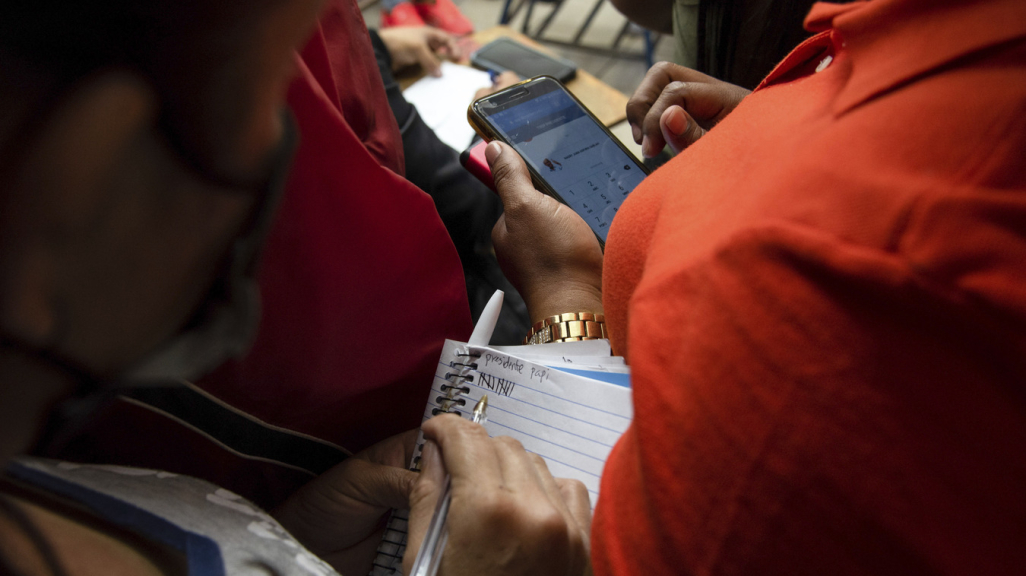
Hondurans tally votes during the November 30 elections. (AP)

Share

Hondurans Await Result of a Presidential Election Locked in a Dead Heat

By Khalea Robertson

A thin margin separates Trump-endorsed Tito Asfura of the National Party and Salvador Nasralla of the Liberals in a partial preliminary vote count.

Hondurans have been left in the lurch, awaiting confirmation of who will be their next president. Almost 40 hours after polls closed on November 30, the head of the National Electoral Council (CNE) announced that the partial, preliminary results showed a “technical tie” between Nasry “Tito” Asfura of the National Party and Salvador Nasralla of the Liberal Party.

Election authorities suspended the preliminary quick count on December 1 due to what they later said was a technical issue with the digital transmission of the votes. At that time, with 57 percent of tally sheets reported, the two leading hopefuls had each earned around 40 percent of the vote share with Asfura having a 515-vote advantage over Nasralla. At the restart of the public vote count in the afternoon of December 2, Nasralla pulled ahead of Asfura by over 5,000 votes with 64 percent of the sheets processed. 

In distant third place was Rixi Moncada, the candidate of the leftist, governing Liberty and Refoundation (Libre) party. Moncada served as both a finance (2022–2024) and defense secretary (2024–2025) in the administration of incumbent President Xiomara Castro, whose 2021 electoral victory with the Libre party—formed in 2011 with her husband, deposed ex-President Manuel “Mel” Zelaya (2006–2009)—broke up four decades of alternating Liberal and National presidencies.

The next step? The CNE said they would move to a complete, manual count of the ballots. A winner must be declared by December 30. This is a single-round election in which the candidate with the most votes becomes president. The inauguration takes place on January 27.

Reports indicated a calm day of voting across the country despite a tense runup to election day in which the main parties exchanged preemptive accusations of fraud, leading local and international observers to voice concerns about attempts to undermine the credibility of the vote.

Speaking on the night following the election, Moncada claimed that the opposition parties had conspired to set up a “trap” and denounced what she called the “foreign and imperial interference” of U.S. President Donald Trump. Trump endorsed Asfura in a November 28 social media post in which he referred to the National Party candidate as “the only real friend of freedom in Honduras” while labeling Moncada a communist and claiming Nasralla was “pretending to be anti-Communist only for the purposes of splitting Asfura’s vote.”

Trump then offered a pardon to former Honduran President Juan Orlando Hernández (2014–2022), also of the National Party, claiming he was “treated very harshly and unfairly.” In June 2024, a U.S. court sentenced Hernández to 45 years in prison on drug trafficking offenses that occurred both before and during his presidential term, including facilitating the entry of at least 400 tons of cocaine into the United States. Hernández walked free from prison on December 1, 2025. Given the limited and often unreliable voter intention polling in Honduras, the impact of Trump’s declarations on the election is unclear.  

What’s clearer is that the Honduran electorate has taken a rightward shift after just one term of the leftwing Libre government. Xiomara Castro entered office with promises of reducing poverty, curbing corruption, and tackling drug-related violence. Although rates of poverty and homicides have fallen under her administration, they remain among the highest in the region and Hondurans have been living under a state of exception for almost three years. Moreover, anti-corruption efforts have stalled. Plans to establish an International Commission Against Impunity and Corruption, CICIH, never came to fruition as mounting concerns about party control of independent state institutions and multiple corruption scandals tainted Libre’s reputation.

So, who are the two candidates?

The National Party’s Asfura, 72, is a former two-term mayor of Tegucigalpa, the capital city, who also ran for the presidency in the 2021 election. His campaign this year centered on increasing private-sector economic participation, fostering nearshoring opportunities through the establishment of free-trade zones and industrial parks, and improving transport and energy infrastructure. In addition to adding renewable energy sources to the power grid, Asfura outlined a 10-year plan to build over 500,000 social housing units. 

The Liberal candidate Nasralla, 67, is making his fourth attempt to enter the presidential halls. The television sportscaster resigned from his role as Castro’s vice president in April 2024 with complaints of being sidelined. A self-branded anti-corruption crusader, his platform focuses on reducing and digitalizing the state to boost economic activity. His proposals include offering fiscal incentives to foreign and export-oriented business, incorporating hourly paid workers into the formal economy, and an infrastructure plan to construct a “dry canal,” a series of roadworks connecting key ports on the Pacific and Atlantic Oceans. On the security front, Nasralla has identified Salvadoran President Nayib Bukele’s approach as a model for tackling crime.

Nasralla and Asfura have both signaled intentions to move away from Libre’s state-led economic model while rebuilding friendlier relations with the United States and reinstating Honduras’ recognition of Taiwan after a 2023 switch to the People’s Republic of China.

Preliminary results of the legislative election indicate that Asfura’s National Party will occupy 50 of the available 128 seats in the unicameral Congress. It will be the largest share but still short of the 65 needed for a majority. Governability, then, will rest on collaboration with Nasralla’s Liberal Party, which will have 40 congressmembers, almost double its current representation. Together, the two parties’ 90 seats would be enough for the special majority needed to enact Constitutional reforms and other major legislative decisions. Libre earned 34 seats, down from the 50 it holds in the current Congress. Two smaller parties won two seats each. The new legislative session begins on January 25.

Related

Explore