ARTnews Reviews Americas Society's Telenovela Exhibition
ARTnews Reviews Americas Society's Telenovela Exhibition
Telenovelas "are a very important part of Latin America, but also international culture", said the show's curator Aimé Iglesias Lukin to the publication.
What can a telenovela tell us about society? Or about art even? Those questions are central ones to the recently opened exhibition “Telenovela” at the Americas Society in New York. Running through March 27, the show explores a range of cultural, social, and economic messaging inserted in the genre through 52 artworks ranging from the 1970s to present day.
“Telenovelas are a historical phenomenon,” Americas Society chief curator Aimé Iglesias Lukin told ARTnews of her latest exhibition. “They are a very important part of Latin America, but also international culture. They were the most consumed television product of the 1990s. And it’s a way to make, through art, a history of that period and a history of that moment of culture.”
The works on view are made by 57 artists from across Latin America, the Caribbean, Europe, and the United States, providing a range of artistic interpretations in relation to these sociocultural systems through diverse mediums from photography and video to painting and drawings.
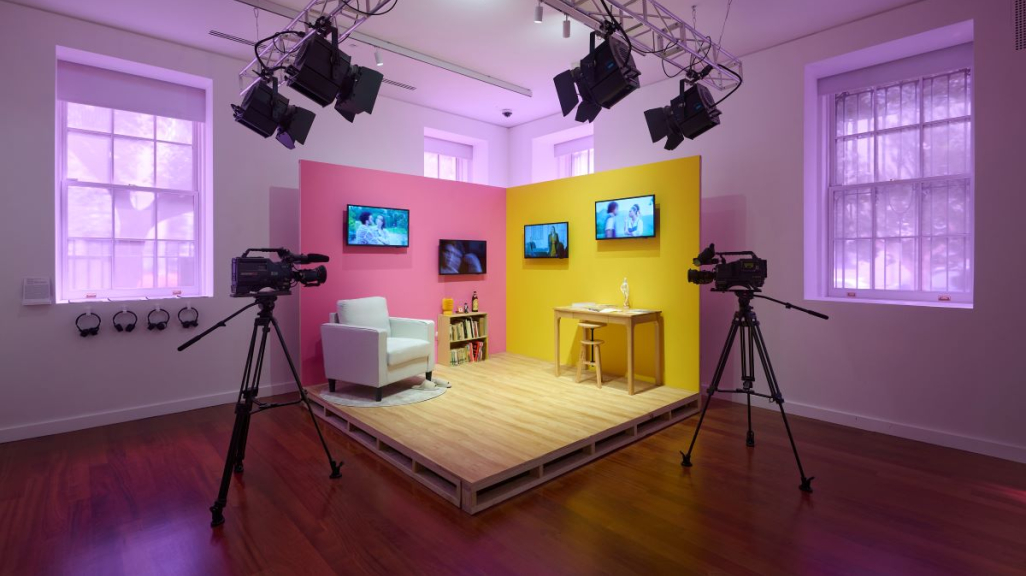
The exhibition opens with a staged telenovela set of four screens on the wall playing melodramatic scenes of Entre la gloria y el olvido (Between glory and oblivion), an art installation by Pablo Helguera, who has been exploring the genre for nearly two decades as part of his ongoing Instituto de la Telenovela (2007–). The set feels like an invitation to enter a fictional world that allows visitors to experience the telenovela through three viewpoints: the writer sitting at the desk creating the plot, the actors performing in front of the cameras, and the audience watching it all unfold.