



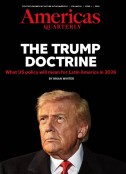
Americas Quarterly's New Issue: History Lessons about the Trump Doctrine in the Region
Americas Quarterly's New Issue: History Lessons about the Trump Doctrine in the Region
The magazine looks at the return of Washington's "big stick" diplomacy in Latin America and what can we learn from the old heavy-handed approach.
Read the press release in Spanish and Portuguese
New York, January 20, 2026 — "As the old adage goes: History doesn’t always repeat itself, but it does sometimes rhyme," writes Brian Winter, the author of the cover story of Americas Quarterly's new issue. "Today, President Donald Trump’s actions in Venezuela, Mexico and elsewhere have prompted comparisons to the more interventionist era of the 19th and 20th centuries, raising questions about what—if anything—history can teach us about what might happen next."

Winter, AQ's editor-in-chief, writes in his article that Trump's policy of interventionism in the region is nothing new, citing examples like Theodore Roosevelt's direct occupation and financial control of Caribbean and Central American countries; Lyndon Johnson's deployment of more than 20,000 troops into the Dominican Republic in 1965 or George H.W. Bush's military operation in Panama to depose of President Manuel Noriega in 1989. However, there are some differences between the current Trump doctrine and the activism of the 19th and 20th century toward the region. Instead of being driven by moralizing ambitions, Trump seems driven by "a comparatively narrow view of U.S. interests," like the need to reduce the flow of drugs and unauthorized migration into the United States, as well as his desire to contain the influence of China in the Americas.
Winter's article, titled "We've Been Here Before," also says that history has taught us to not expect consistency: "doctrines" should be taken with a grain of salt as presidents have often contradicted themselves or changed course. A final history lesson, concludes Winter, is that there's always backlash after interventionism, as it helped fuel the rise of leaders from Fidel Castro to Juan Perón, Daniel Ortega, and Hugo Chávez.

A 2026 Snapshot of Latin America and the Caribbean
Emilie Sweigart, editor at Americas Quarterly, tracks key indicators and political and economic trends to watch in Latin America's 10 largest economies, as well as Guyana and Venezuela after the Trump administration captured the latter country's leader Nicolás Maduro.

Suriname's President Prepares for an Oil Boom
The country's first female president, Jennifer Geerlings-Simons, who took the helm in July 2025, is set to oversee the world's latest oil bonanza, but faces a country in crisis. “If we don’t prepare properly, we will inevitably suffer a resource curse,” she told Jason Pinas, a journalist based in Suriname.

The Unfulfilled Promises of Colombia's Peace Process
María Victoria Llorente, the executive director of the Fundación Ideas para la Paz think tank in Bogotá, writes about why the deal has fallen far short of expectations and what it says about the country today.

Venezuela's Democratic Opportunity
"Today, even with vestiges of the old regime still in place and a difficult road ahead, Venezuela may be facing a generational opportunity," writes Susan Segal, president and CEO of Americas Society/Council of the Americas, who highlights in her article that achieving a successful outcome will require determined leadership, supported by the United States and other partners, to restore rule of law and basic governance.
Also in this issue:
- Vanessa Rubio, professor of practice at the School of Public Policy at the London School of Economics and senior advisor at McLarty Associates, reports on Mexico facing critical decisions on state-owned companies, fiscal deficit, and the nation's low productivity.
- AQ's company profile focuses on Agrosmart, a Brazilian company that uses artificial intelligence as well as climate and soil sensors to help farmers navigate decisions on planting, irrigation and crop care. Freelance journalist Flávia Mantovani writes about the challenges and opportunities of this startup that aims to lead in the agricultural technology market in the region.
The full issue is available at americasquarterly.org
View the PDF.
To request interviews with the authors, or to request publication permission, please contact AS/COA Media Relations at mediarelations@as-coa.org