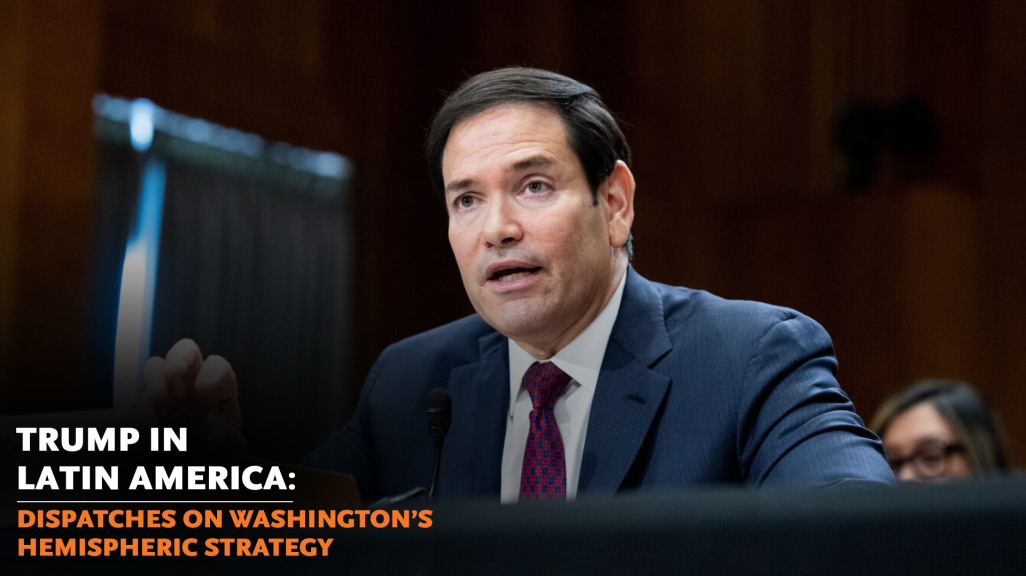
Secretary Marco Rubio testifies to the U.S. Senate. (AP)

Secretary Marco Rubio testifies to the U.S. Senate. (AP)

Share

Trump in Latin America: Rubio Talks Venezuela, Mexico Talks Trade, Lula Talks to Trump 

As President Trump starts his second year in office, read AS/COA's roundup covering the White House's Western Hemisphere strategy. 

The Americas now lies at the center of Washington’s foreign policy calculus. If there was any doubt about that fact after the December 2025 National Security Strategy outlined “the Trump Corollary to the Monroe Doctrine,” which seeks to “restore American preeminence in the Western Hemisphere,” the January 2026 capture of Venezuela’s Nicolás Maduro made it crystal clear.  

With that in mind, AS/COA Online is kicking off a series of regular dispatches to help readers stay on top of the renewed U.S. focus on Latin America and the Caribbean, just as U.S. President Donald Trump launches the second year of his term. Get ready: There’s a lot of ground to cover from the first week.  

Throughout the first year of the Trump administration, we tracked the White House policy on trade, immigration, security and more. Catch up on what happened in our year-one guide.  
The Rubio report on Venezuela. “No one here is telling you: this is what we want to see in the long term,” said Secretary of State Marco Rubio in his January 28 testimony to the Senate Foreign Relations Committee, speaking about U.S. cooperation with Venezuela’s interim leader Delcy Rodríguez, who served as vice president during the Maduro regime. In Rubio’s first public briefing to lawmakers following Maduro's capture, senators challenged the secretary on the timeline for Venezuelan elections that could loosen Rodríguez’s grip on power.

“You can have elections...but if the opposition has no access to the media, if opposition candidates are routinely dismissed and unable to be on the ballot because of the government, those aren’t free and fair elections,” countered Rubio, outlining a three-step plan for stabilization, recovery, and transition of Venezuela’s economy and democracy. “We’re not going to get there in three weeks.”  

On January 25, a Louisiana-bound tanker left Venezuela carrying the first U.S.-bound shipment of a 50-million-barrel deal between Washington and Caracas. Rubio told senators that revenues from the sale of that previously sanctioned oil would be funneled into a U.S.-supervised fund to finance Venezuelan services, such as policing and healthcare. The fact that the fund is Qatar-based has raised eyebrows; Rubio contended the location avoided sanctions-related legal complications. Looking ahead, the secretary expressed cautious optimism about a reform making its way through the chavista-controlled National Assembly to bring private investment into the hydrocarbon industry.  

Rubio also met with Venezuelan opposition leader María Corina Machado on Thursday, after which she told reporters she supports a "real transition” rather than a “Russian-style one where mafias remain in control,” adding: “Venezuela will be free. And when that happens, freedom, security and stability will spread across the Americas—including to Cuba and Nicaragua.”   

Mexican oil to Cuba? Yes, no, maybe so. Is the Sheinbaum government feeling the heat of U.S. pressure to halt Havana’s oil supply? A January 26 Bloomberg scoop reported that Mexican state oil firm Pemex skipped a fuel shipment destined to arrive in Cuba by the end of the month. But two days later at a press conference, President Claudia Sheinbaum suggested the flow of oil in the form of “humanitarian aid” would continue.    

Earlier this month, Trump celebrated the end of Venezuelan oil supplies to Havana and warned—in all caps on social media—that “there will be no more oil or money going to Cuba.” Still, while Venezuela’s shipments dwindled in recent years, Mexico’s grew. In 2025, it overtook Caracas to become the Caribbean country’s top supplier, accounting for 44 percent of Cuban crude imports, per the Financial Times.   

Between a rock and a hard place. Cuba isn’t the only pressure point for U.S.-Mexico ties. Trump has long hinted at U.S. land strikes on drug cartels inside Mexican territory, and Washington’s capture of Nicolás Maduro places that threat in sharp relief. Since Trump took office, Mexico has sought to keep the peace, extraditing more than 100 alleged top criminals to the United States, with 37 of them sent over on January 20. Then, on January 23, with FBI head Kash Patel at his side in Mexico City,  Security Secretary Omar García Harfuch announced that Ryan Wedding, a Canadian Olympic snowboarder turned drug kingpin, had been placed in U.S. custody. Rival narratives dispute whether Wedding turned himself in or if the FBI had a hand in his arrest on Mexican soil—a claim Sheinbaum rejects.  

Security tensions also cast a shadow over this year’s review of the USMCA trade pact—a touchy point for Mexico, given some 80 percent of its exports are U.S.-bound. On January 29, Sheinbaum spoke with Trump in what she described as a “cordial” call during which the two leaders discussed trade and security cooperation. This came a day after Mexican Economy Secretary Marcelo Ebrard was in Washington to meet U.S. Trade Representative Jamieson Greer and Commerce Secretary Howard Lutnick. Greer’s readout called for “structural and strategic reforms” to USMCA to cover tighter rules of origin. 


Carney keeps going. Canada, the other partner in the trilateral USMCA deal, is pulling no punches, even after Trump threatened a 100 percent tariff on his neighbor over its potential deal-making with China. Prime Minister Mark Carney, who denied intentions to ink a free-trade pact with China, this week told reporters that Ottawa intends to ink 12 new trade deals in the next six months to diversify beyond the U.S. market. “I meant what I said in Davos,” he added, alluding to his headline-grabbing speech at the World Economic Forum, which describe the end of the rules-based international order.  

Ecuador’s ICE-y reception. “You cannot enter here. This is a foreign government’s property.” Staff at Ecuador's Minneapolis consulate stopped Immigration and Customs Enforcement (ICE) agents at the door on Tuesday. Ecuador's Foreign Ministry responded by filing a complaint with the U.S. embassy in Quito against the “attempted incursion.”   

ICE's entry without permission would have violated the Vienna Convention on Diplomatic Relations, much as Ecuador was accused of doing in 2024 when it raided the Quito-based Mexican Embassy to detain a former vice president facing embezzlement charges.  

Haiti’s crisis in waiting. With just over a week until its February 7 expiration date—and little clarity on who is to lead Haiti between then and tentative August 30 elections—the country’s Transitional Presidential Council, or CPT, finds itself embroiled in a standoff with the U.S. government.   

Over the last week, the State Department issued visa restrictions on four CPT members after the interim governing body ignored U.S. warnings against attempting to oust acting Prime Minister Alix Didier Fils-Aimé. The State Department notices accuse the unnamed CPT members of enabling criminal groups and follow a January 23 phone call in which Rubio told Fils-Aimé that the “United States will ensure there is a steep cost for corrupt politicians who support vicious gangs and wreak terrorism on Haiti.”   

Fils-Aimé remains in place for now as CPT President Laurent Saint-Cyr rejected signing off on the removal order endorsed by five of its seven voting members. 

Lula calling. President Luiz Inácio Lula da Silva continues his mission to defend a multilateral world order, even when it puts him at odds with his U.S. counterpart. The Brazilian leader spoke by phone with Trump on January 26 to discuss a raft of issues, spanning from bilateral trade to peace in the Middle East.  While Lula’s post-conversation statement pointed to positive signs after last year's bitter bilateral tariff tussle, he said he had advised that Trump’s newly created Board of Peace should be "limited to the Gaza issue and provide a seat for Palestine.” He has separately criticized Trump for trying to create “a new UN where he is the only owner.” Argentina, El Salvador, and Paraguay, meanwhile, have signed up to join Trump’s Board.   

A stalwart of Latin America’s left, Lula has leveraged recent international engagements to elevate himself as a global statesman who reaches across the political spectrum. While in Panama to visit President José Raúl Mulino and attend a CAF forum on January 28, he held a one-on-one meeting with Chile’s right-wing president-elect, José Antonio Kast. After jetting off to India and South Korea in February, Lula plans to travel to Washington in early March to continue his conversation with Trump face to face.  

What’s Next in Washington?

Mr. Petro comes to Washington. Before Lula arrives, another Latin American leftist will visit the White House. Colombian President Gustavo Petro meets Trump on February 3, despite their months-long ping-pong of insults. But in a January 9 phone call, Trump, who once called Petro an “illegal drug leader,” reached a détente with his Colombian counterpart, whose U.S. visa was revoked in September after he called on U.S. soldiers to disobey their government while at a New York rally supporting Palestine.  

Sparks may still fly at the White House: no sooner had Washington issued Petro a five-day visa for his trip when he called for Maduro’s return to face trial in Venezuela.  

Find out what happened next week; AS/COA Online will cover Petro’s meeting with Trump in the upcoming dispatch.

Carin Zissis and Khalea Robertson authored this week’s roundup. 

Related

Explore