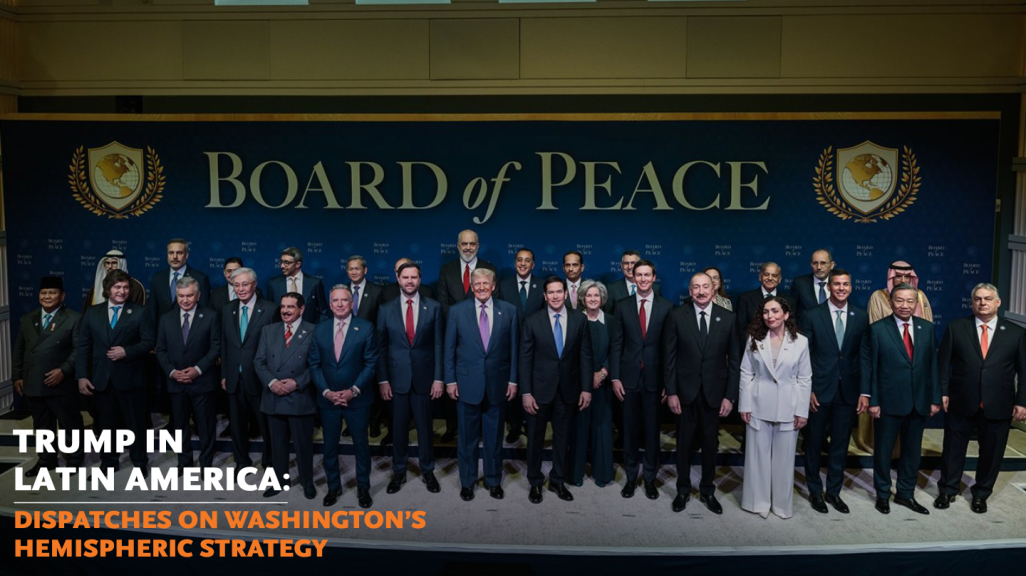
Attendees of the first Board of Peace meeting. (White House)

Attendees of the first Board of Peace meeting. (White House)

Trump in Latin America: The Board of Peace Roster, A Cuban Call, and Moves on Nicaragua

By Carin Zissis and Chase Harrison

Feb 13-19: More U.S. officials visit Venezuela as a Canadian business delegation heads to Mexico ahead of the USMCA review.

Welcome back to our weekly dispatch of stories on the U.S. role in Latin America. Follow us each week and see previous roundup at as-coa.org/dispatches, or sign up to receive them via LinkedIn

Now boarding

On February 19, Donald Trump hosted the first meeting of his Board of Peace, a body he formally established at Davos in January that is empowered by a UN Resolution to oversee a peace and reconstruction plan in Gaza. The Latin American members of the Board are Argentina, El Salvador, and Paraguay, countries whose leaders have aligned themselves with Trump on major international issues. Neither Brazil nor Mexico accepted their invitations to join the Board, though President Claudia Sheinbaum sent an observer to the inaugural meeting

Although the Board’s mandate centers on Gaza’s future, at the meeting, Trump spoke about Iran and said he intends for the Board of Peace to also be “looking over the United Nations and making sure its runs properly.”

Countries are announcing their funding commitments to the Board and a Gaza peace plan at the meeting. 

Another regime on the radar

Nicaragua, often mentioned in tandem with Cuba and Venezuela as one of Latin America’s authoritarian regimes, has managed to avoid as much attention as the other two countries thus far this year, as The Economist reported last week. That doesn’t mean Washington isn’t turning its sights on Nicaraguan co-leaders Daniel Ortega and Rosario Murillo. At the end of January, the State Department called out Murillo’s “illegitimate grip on Nicaragua,” though it did not move to expel the country from the Central American Free Trade Agreement. But on February 18, Secretary of State Marco Rubio announced U.S. sanctions against a Nicaraguan prison director for “gross violations of human rights.” 

Managua has shown signs of wanting to appease Washington. On February 15, Nicaragua announced an end to visa-free entry for Cubans, Haitians, Venezuelans, and more than 100 other nationalities, closing an entry point for those seeking to migrate northward to the United States. 

Rubio’s Castro convo

Axios reported this week that Rubio has been holding secret talks with Raúl Guillermo Rodríguez Castro, the grandson and close confidante of Cuban ex-president Raúl Castro, in lieu of communicating with the official government channels. An anonymous senior Trump official was quoted by the outlet as saying: “I wouldn’t call these negotiations as much as discussions about the future.” 

Venezuelan visitors

Days after U.S. Energy Secretary Chris Wright traveled to Venezuela, SouthCom Commander General Francis L. Wright headed to Caracas to meet with the country’s interim government on February 18. 

More U.S. visitors are expected; on February 13, Trump suggested he would travel there at some point, which would mark the first time a U.S. president made a trip to Venezuela since 1997. 

On the same day, the Treasury Department issued two more Venezuela-related general licenses: one allowing companies to negotiate contracts to produce oil and gas in the country and another to allow certain major oil firms to invest in new oil-and-gas operations, paving the way for more U.S. firms to operate in Venezuela. 

O Canada (in Mexico)

The two North American countries that sandwich the United States deepened ties this week when Canada-U.S. Trade Minister Dominic LeBlanc led a 370-person business delegation to Mexico City, Guadalajara, and Monterrey, both to strategize ahead of this year’s review of the trilateral USMCA deal and to strengthen bilateral economic relations. Mexico is expected to deploy a similar delegation to Canada in the future.

Aside from USMCA, the two countries are also part of the Comprehensive and Progressive Agreement for Trans-Pacific Partnership (CPTPP). Per Politico, Canada’s Prime Minister Mark Carney is leading talks between the European Union and an Indo-Pacific trade bloc that could bring together as many as 40 countries. The United States is not currently among them. 


Must reads of the week

Canada’s big trade delegation to Mexico came after Carney visited the country in September. Will Carney’s moves to build an alternative to the Trump Doctrine resonate in the Americas? SAIS’ Christopher Sands explores answers in Americas Quarterly

Meanwhile, Bloomberg’s Juan Pablo Spinetto writes that Mexico, now Washington’s biggest export market, has plenty of cards to play at the USMCA negotiating table. That means it could be time to call Trump’s bluff amid rumors the U.S. leader wants to quit the pact. 

The battle against narcotrafficking in the Americas has been a major focal point for the Trump administration. What does that look like? InSight Crime maps out the answer, showing each country’s role, both in the illicit drug trade and in U.S. collaboration around counternarcotics. 

Related

Explore