Brazil oil workers

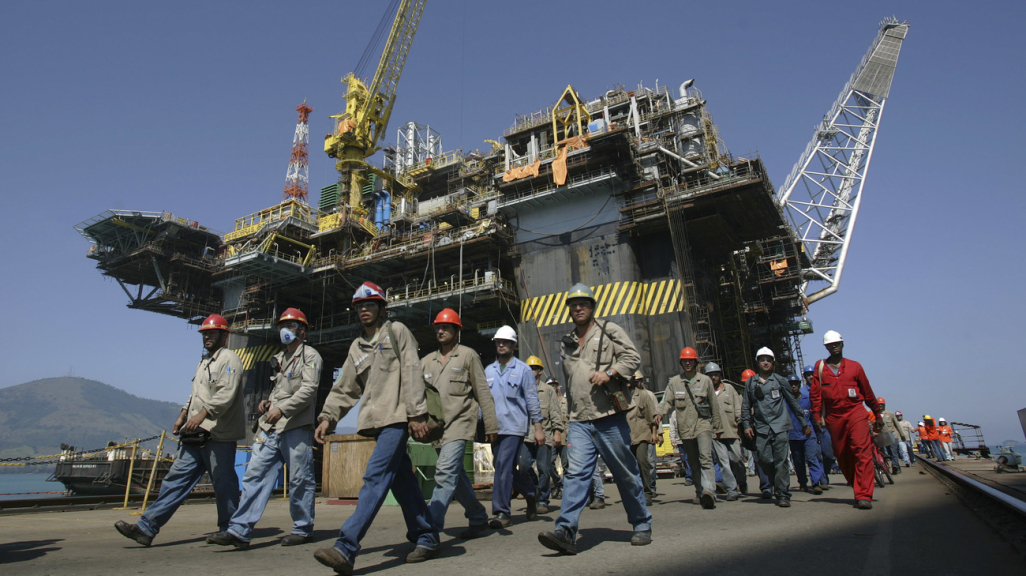
Workers at a Brazilian oil rig. (AP)

In Charts: Latin American Oil Gains Ground in a Disrupted Global Market

By Khalea Robertson

The region’s top oil producers are boosting output and exports even as conflict disrupts energy flows through the Strait of Hormuz.

The Strait of Hormuz, once the conduit for a fifth of the world’s crude oil shipments, has been largely closed since the United States and Israel began hostilities with Iran in February. Daily crude oil traffic through the Strait, which connects Gulf State producers to global buyers, dwindled from 20 million barrels per day (bpd) before the war to fewer than 4 million bpd in early August.   

While that side of the world scrambles to find alternative trade routes and diversify energy sources and suppliers, export revenues for Latin American and Caribbean energy producers have benefited from soaring oil prices. But analysts caution that the net macroeconomic effect of the disruption in the global energy market varies among the region’s producers and is still a little murky.

AS/COA Online charts recent trends in oil production and exports from Latin America’s top six oil producers—Argentina, Brazil, Colombia, Guyana, Mexico, and Venezuela—to examine how the region’s oil market has evolved during the ongoing disruption to the global fuel supply. 

Has Latin America’s crude oil production risen?

“It’s not like you have closed production that you open at the drop of a hat,” former energy executive and non-resident Baker Institute Fellow Luis A. Pacheco told AS/COA Online, pointing to geological and infrastructural constraints on increasing output quickly. Even if disruptions to supply from Gulf states persist, he added, Latin America’s production capacity would not be enough to replace that of the Middle East. In 2025, Latin America produced 11 percent of the world’s crude oil; the Middle East produced 30 percent.

But countries such as Argentina, Brazil, Guyana, and, more recently, Venezuela, were already undertaking efforts to expand their energy sectors. Argentina’s big push over the last decade to develop its Vaca Muerta shale fields, for example, means the country’s oil production rose 71 percent since 2016. Guyana, which started extracting oil commercially in 2019, already produces over 900,000 bpd, marking an unprecedented development rate in the offshore sector.  

Regional oil production in 2025 jumped 20 percent from the previous year, with Brazil and Guyana responsible for much of that growth. Even before the outbreak of the war, the International Energy Agency had forecast that the Americas, which includes the United States and Canada, would drive most of the world’s oil supply growth in 2026. Brazil’s production crossed 4 million bpd this year and hit an all-time monthly output record in June. An additional offshore development set to come on stream in Guyana later this year could see the region’s fast-emerging energy powerhouse churn out more than 1 million bpd by the end of 2026. Venezuela, home to the world’s largest oil reserves, has been gradually recovering its production capacity in cooperation with the U.S. government, which has eased sanctions and overseen the country’s oil revenue since its January 3 operation removing ex-leader Nicolás Maduro.  

Have Latin America’s crude export revenues grown?

In recent months, India and China have upped Brazilian crude purchases to replace lost supply from the Gulf. In the first five months of the year, Brazil’s crude exports rose 87 percent to China and 138 percent to India over the entirety of 2025. And in May, Venezuela sold over 1.25 million bpd, driven in large part to rising shipments to India, the United States, and Europe. That tally helped the country hit its highest monthly sales in more than seven years.

In Mexico, state oil company Pemex, the country’s main oil producer, posted a 31 percent year-over-year growth in export sales in the second quarter of 2026, even as profit fell in the same period.  


But one country stands to gain the most among the region’s net energy exporters.  “Guyana is, perhaps, the main beneficiary, because it's a country that produces so much oil per capita,” said Francisco Monaldi, who heads the Latin America Energy Program at Rice University’s Baker Institute for Public Policy. With a population of just over 800,000 and no refining capacity, Guyana exports nearly all of the oil it produces.

But, as profit margins for refineries expand, Monaldi said the region could be doing a better job at marketing its downstream products. “ Latin America is tricky in the following sense: Say you produce mostly for your domestic market, but your government does not allow you to increase the prices, as is happening a little bit in countries like Brazil, and to some extent in Mexico, and even in Venezuela. Then you will not benefit that much.” 

What’s on the economic horizon for oil producers?

While regional oil exporters can reap the benefits of crude prices not seen since the 2022 start of Russia’s invasion of Ukraine, Pacheco cautions about whether that translates to a noticeable improvement in GDP growth rates for a particular country. “The impact of the oil industry in Mexico, for instance, or in Brazil, is not as much, because they are well-diversified economies,” he said. A May 2026 report from the UN Economic Commission of Latin America and the Caribbean adds that “weaker global demand, supply chain disruptions, [and] reduced international trade” could cancel out the short-term export and fiscal benefits for Latin America’s energy exporters.

In the same vein, Monaldi emphasized the need to factor in the impact of higher prices on other essential inputs disrupted by the Strait’s closure. More expensive natural gas and refined oil products, such as aviation fuel and diesel, affect the trade balance of Mexico, already a net fuel importer although it produces significant amounts of crude oil. Meanwhile, countries with large agricultural sectors, like Argentina and Brazil, have faced the impact of rising fertilizer prices, he pointed out.

In terms of attracting investment, Diego Rivera Rivota, a senior research associate at Columbia University’s Center on Global Energy Policy, argues, “This volatility and relatively higher prices are not necessarily signals for the oil and gas industry to develop new projects. [Firms] are looking at a multi-year horizon, not a couple weeks or months.”  

But with some countries in the region having already started a process of scaling up production, Monaldi said South America has become “a much more attractive place to invest for companies because it has a lot of potential for growth and is far from the geopolitical hotspots in the world.” 

Related

Explore