2026 COA Symposium: Latin America's Next Chapter—Growth, Investment, and the AI Economy
2026 COA Symposium: Latin America's Next Chapter—Growth, Investment, and the AI Economy
Get a recap and videos of our annual event in Miami, convened more than 500 corporate leaders focused on what’s driving regional transformation.
The 2026 Council of the Americas Symposium gathered over 500 regional corporate leaders—including CEOs, company founders, industry pioneers, and government officials—from across Latin America's diverse sectors and geographies. Through a series of public and private sessions focused on the theme “Latin America’s Next Chapter: Growth, Investment, and the AI Economy,” this full-day business conference spotlighted figures driving the region's transformation and explored the ideas, strategies, and innovations shaping its future.
Speakers:
- Athina Kanioura, CEO Latin America Foods, Global Chief Strategy & Transformation Officer, PepsiCo
- Andrés Gluski, CEO, The AES Corporation
- Carlos Capistrán, Head of Latin America and Canada Economics, Bank of America
- Can Kuterdem, President, Latin America and Canada Region, Philip Morris International
- Mauricio Janauskas, Managing Partner, Spanish Latin America, McKinsey & Company (moderator)
- Maria Lourdes Teran, Vice President, AS/COA Miami Office (opening remarks)
"Our purpose today is not simply to discuss Latin America’s next chapter. It is to help shape it," said AS/COA Vice President Maria Lourdes Teran to kick off the 2026 Council of the Americas Symposium. Teran introduced the first panel of the day, which gathered executives heeding that call as they opened the discussion on how Latin America's private and public sectors can collaborate to best utilize the region's natural and human resources, as well as AI technologies, to stimulate GDP growth.
"We have to be dealing with productivity as if it were a crisis, and we need to be delivering on that," said Bank of America's Carlos Capistrán, pointing out that Latin America's average GDP growth of around 2 percent lags behind the almost 5 percent growth for all emerging markets on average. The economist added that governments need to work on ensuring fiscal stability and rule of law.
Andrés Gluski, CEO of The AES Corporation, added to Capistrán's case, stressing the need for policy continuity across administrations to foster a stable, and thus attractive, investment environment in the region. In response to moderator Mauricio Janauskas' question on the region's potential "to become a real opportunity for data centers," Gluski noted that Latin America "has the cleanest [energy] grid on the planet" and could see increasing construction of these facilities if the United States enacts greater regulation. But, he added, the real potential for the region comes with AI adoption. Through "smart government policies for investing in public infrastructure," these technologies could improve the lives of "the bottom 50 percent of the population," he said.
Bringing his experience in South Korea and Poland to the conversation, Can Kuterdem of Phillip Morris International highlighted the importance of collaboration between the public and private sector to attract foreign investors. Kuterdem promoted not only deregulation, but also "more sensible" regulation to bring "more money, more foreign direct investment, and with that, additional resources [that] flow into the economy to increase productivity."
PepsiCo's Athina Kanioura shared that her company is already planning to triple its investment in infrastructure across Latin America. One big draw of the region? The wealth and quality of its agricultural resources. "The agro-food industry [and] agrotech in Latin America is not just a source of wealth for the community, but it’s also a source of wealth if you think of the potential GDP growth it can bring," she said, noting PepsiCo's intention of exporting more from Latin America to the United States. Looking ahead to changing labor dynamics following recent reforms in Mexico and Brazil, the region's largest economies, Kanioura said AI is already helping PepsiCo save on labor costs and improve efficiency.
Speakers:
- Carlos Barrera, CEO, Atlas Renewable Energy
- Ricardo Alário, CEO, ODATA
- Ximena Rincón, Minister of Energy of Chile
- Sean Ludick, President & COO, Voltron Technology
- Candela Macchi, Head of Latin America Ratings & Research, Moody’s Ratings (moderator)
"The opportunity is there for the region, but it will require a lot of coordination from governments, energy developers, developers of data centers, and technology companies. And the measures that we take today as a region will really define if Latin America is merely a participant in this AI revolution or if it’s the region that will power it," said Candela Macchi of Moody’s Ratings. In a panel on powering the AI economy during the 2026 Council of the Americas Symposium, Macchi, the moderator, asked speakers about what it would take for Latin America reach its data center potential.
"The opportunity for the people in this room right now with the current headwinds that U.S. is facing with data centers is huge for Latin America," explained Sean Ludick of Voltron Technology. With U.S. enthusiasm for data centers dimmed, investors are looking to Latin America where ample energy and developed infrastructure presents a fruitful environment for investment. “I think we need to demystify the LatAm risk,” said Carlos Barrera of Atlas Renewable Energy, explaining that there's variance across in the region in data center readiness. Speakers highlighted Brazil, Chile, and Mexico as the region's strongest destinations.
Ximena Rincón, Chile's energy minister, covered what governments can do to develop their data center industries. Policies, she said, need to create certainty for investors, speedy permitting, and a sense that the data management will benefit the country. "Latin America can leverage its wealth in terms of renewable energy generation, gas, and even diesel, ransforming the region into an opportunity for the world, as well as for its own inhabitants," Rincón concluded.
Speakers:
- Adam Kaufman, Head of Industry Transformation, Anthropic
- Paula Bellizia, Vice President for Latin America, Amazon Web Services
- Felipe Villamarín, Co-Founder, Rappi
- Alejandro Anderlic, Director of Government and External Affairs, Latin America, Salesforce (moderator)
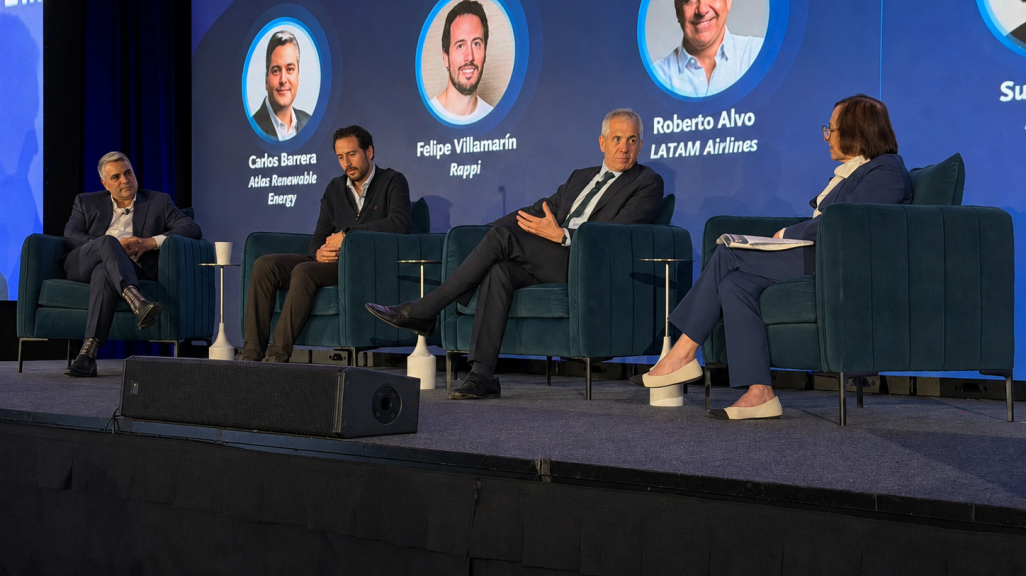
"AI is not in the future anymore. It's happening. It's here," said Amazon Web Services Vice President for Latin America Paula Bellizia during a panel on AI adoption at the 2026 Council of the Americas Symposium. When moderator Alejandro Anderlic of Salesforce asked how well the region is closing its execution gap, Bellizia answered that many companies still talk about AI as something in the future. She added that tech debt and limited cloud adoption could slow the region down, and that one in every two Latin American leaders names talent as the top barrier to faster adoption.
"I don't think that there is an ambition gap in Latin America. I don't think that there's a technology gap," said Anthropic's Adam Kaufman, who framed the region one of the fastest growing. In his view, the challenge lies in how the work itself is designed. He pointed to Mercado Libre, which tasked Claude with maintaining its entire software estate. The company doubled the amount of code it ships while improving quality, and its finance team then cut the time needed for the monthly close by a third.
How can companies use autonomous agents to cut costs and grow revenue, and what guardrails do they need? Kaufman described a shift from AI that answers questions to AI that does the work. He cited Mexico's Kavak, which now assigns one agent to guide each customer through buying and financing a car, a process that once involved several teams and took weeks. The company's conversion rate doubled and customer satisfaction tripled. On governance, he advised keeping a human in the loop for irreversible decisions, making every agent action traceable, and putting a business owner, not the IT team, in charge. "If you do it correctly, this is what allows you to take your foot off of the brake," he said.
Felipe Villamarín of Rappi said mapping employees' workflows showed inefficiencies the company hadn't seen. "You think you know, but you really don't know what people do in your company," he said. Rappi now runs fleets of agents that tailor the app to each customer, plus an "air traffic control" agent that monitors live orders and steps in when something goes wrong. The company also sets AI adoption targets for each role, and he said about 90 percent of employees meet them.
On talent, Bellizia said AWS has trained 2 million people in Latin America in cloud skills and has committed to training another 2 million by 2028. "No company alone and no government alone is going to be able to fix the talent gap," she said. For his part, Kaufman urged executives to give a business leader one process to transform and ask for results within 90 days.
Speakers:
- Richard J. Cooper, Partner, Cleary Gottlieb Steen & Hamilton LLP (introduction)
- Roberto Alvo, CEO, LATAM Airlines
- Gabriela Frías, Business Anchor, CNN en Español (moderator)
"[Roberto Alvo] faced one of the largest and most complex corporate restructurings ever undertaken without a roadmap or a clear vision as to how or what could be done," explaining Richard J. Cooper of Cleary Gottlieb Steen & Hamilton LLP. In his introduction, Cooper detailed how Alvo's success navigating his company through the Covid pandemic and bankrupty, combined with his kindness and humanity, make him a worthy recipient of BRAVO's CEO of the Year honor.
How did Alvo manage his company through difficult times, asked moderator Gabriela Frías in a conversation at the 2026 Council of the Americas Symposium. "If you asked me what helped, I think it’s hardship … That’s what matters when things are more difficult, having gone through hardship." Alvo spoke about showing up for his employees and his customers during the height of the pandemic, who looked to him for reliability and strength in a difficult time. The CEO also expressed that he is thankful the government didn't intervene on behalf of LATAM. "We had to find our way and we did," he said.
Alvo's leadership during the pandemic saw LATAM transport one third of vaccines consumed in the region and help stranded travelers get home. "We cannot forget that we as a company are a citizen and as a citizen we need to do more than simply comply with the law. We have to help,” Alvo explained. "Companies that take responsibility for contributing what they do to the societies where they operate will have the good will of the citizens and that, in my mind, is extremely important."
Speakers:
- Roberto Lara, CEO, Castillo Hermanos
- Daniel Hickey, Vice President of Government Relations for North America, Embraer
- Martín Migoya, Co-Founder and CEO, Globant
- Julio Figueroa, CEO of Latin America, Citi (moderator)
"Historically, we thought about the relationship between Latin America and [the] U.S. in trade terms," said Citi's Julio Figueroa as he opened this panel on Latin American companies expanding into the U.S. market at the 2026 Council of the Americas Symposium. That relationship is now changing, he said, as companies move from exporting to building factories and making acquisitions in the United States. Still, Latin America accounts for only about 2 percent of foreign direct investment in the country, compared with roughly 20 percent of U.S. trade, a gap that Figueroa said is where the opportunity lies.
"It's much more than a market for us. It's a strategic home," said Daniel Hickey of Embraer. The Brazilian aircraft manufacturer opened its first U.S. office in Fort Lauderdale in 1979, and today the United States accounts for around 65 percent of its revenue. Hickey said Embraer supports more than 10,000 U.S. jobs through its suppliers, and has committed to invest $500 million to build in the United States if the U.S. Air Force selects its KC-390 aircraft.
Globant co-founder and CEO Martín Migoya recalled how, in 2006, his team in Argentina began developing software for Google, which referred the company to Electronic Arts and later Disney. Globant then grew through U.S. acquisitions from Seattle to New York. Asked by Figueroa how AI will change the way companies operate, Migoya said professional services firms will shift to "AI-native services," where agents do the heavy lifting under human supervision and clients pay per outcome rather than per hour. "It's not a $300 billion market like the cloud. It's a $6 trillion market that must evolve into something different," he said.
Roberto Lara said Castillo Hermanos, founded in Guatemala in 1886, now has more than 22,000 employees in nine countries, and the United States is its second-largest operating country. After a decade of searching for the right U.S. platform, the group closed its acquisition of Harvest Hill, maker of SunnyD and Juicy Juice, in May 2025, the largest deal in its history. Lara credited the company's human-centric culture with a smooth integration. "We're in the U.S. for the next at least 100 years," he said.
For executives considering a first U.S. investment, Lara advised making sure "you have the right to win" before entering the market, and finding the right local partners. Migoya called the United States the world's most meritocratic market, saying success there requires consistency, long-term planning, and full commitment.