


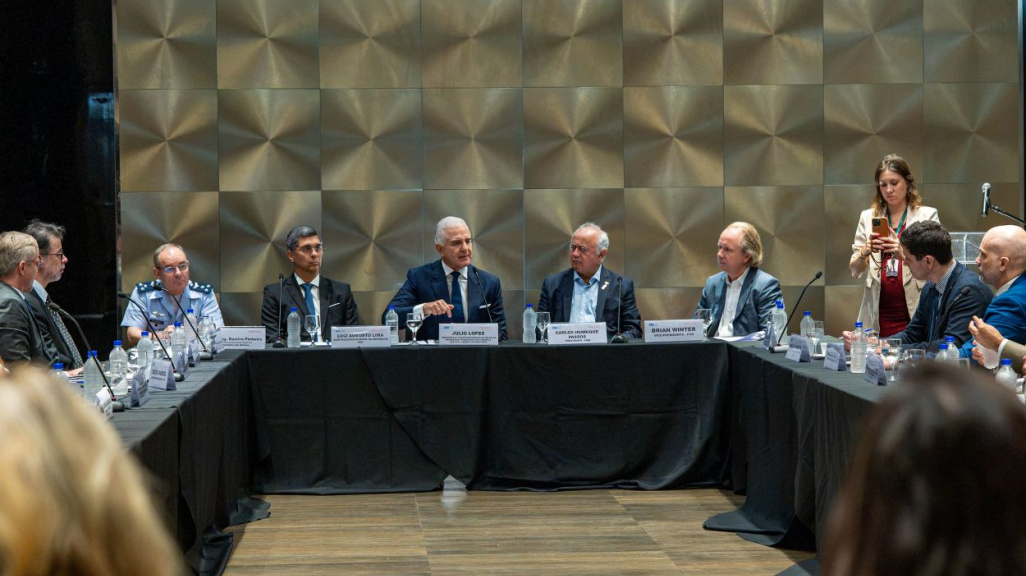
Council of the Americas and CNI Host Roundtable on Illicit Trade in Brasilia
Council of the Americas and CNI Host Roundtable on Illicit Trade in Brasilia
At the event, leaders discussed the challenges and pathways to strengthening Brazil's response to illegal cross-border activity.
Representatives from the public and private sectors and international organizations met on July 2 to discuss strategies for tackling cross-border illicit trade, in a program organized by Council of the Americas (COA), in partnership with Brazil’s National Confederation of Industry (CNI). The event highlighted the importance of institutional cooperation in reducing the impact of the illegal market on Brazilian industry, which, in turn, will strengthen competitiveness, investment, and economic development.
COA's Vice President of Policy Brian Winter emphasized during the debate that illicit trade is a global challenge affecting both the economy and the security of nations. "The response to illicit trade requires continuous enforcement, cooperation between the public and private sectors, and regulatory frameworks. The solution depends on joint effort," he said.
CNI's legal director, Alexandre Vitorino, stated that the issue is an institutional priority due to its impact on the business environment. "Illicit trade directly affects legal certainty and, above all, the competitiveness of our market," he explained. "A strong economy depends on clear rules and fair competition. Companies that choose to invest in Brazil, that innovate, create formal jobs, and pay their taxes on time need the assurance that the market is balanced."
The Brazil Legal Special Survey, conducted by CNI in May 2026, shows that 29 percent of companies in the country report losses due to the manufacture or sale of irregular products. The practice, in addition to posing risks to consumers, constitutes unfair competition and causes direct losses to formal industry.
Illicit trade today represents an important source of financing for organized crime, strengthening the criminal networks that operate across borders and multiple sectors.
Representative Júlio Lopes, president of the Parliamentary Front in Defense of Intellectual Property and Against Piracy, drew attention to the evolution of criminal organizations. "Crime today is electronic, tied to international trade chains, which presents new challenges and brings a different level of complexity," Lopes said.
After initial remarks from the authorities, the program continued with a panel discussion among industrial associations and invited companies. The debate allowed for an exchange of experiences and perspectives from the private sector, focusing on the challenges of combating customs violations, in particular smuggling, tax evasion on imports, piracy, and counterfeiting, and their impact on the competitiveness of Brazilian industry.
Also participating in the roundtable were representatives of Brazil's Federal Police, the Federal Revenue Service, the Ministry of Defense, the Federal Public Prosecutor's Office, the United Nations Office on Drugs and Crime (UNODC), and sector-specific industrial associations.
Press contact: mediarelations@as-coa.org