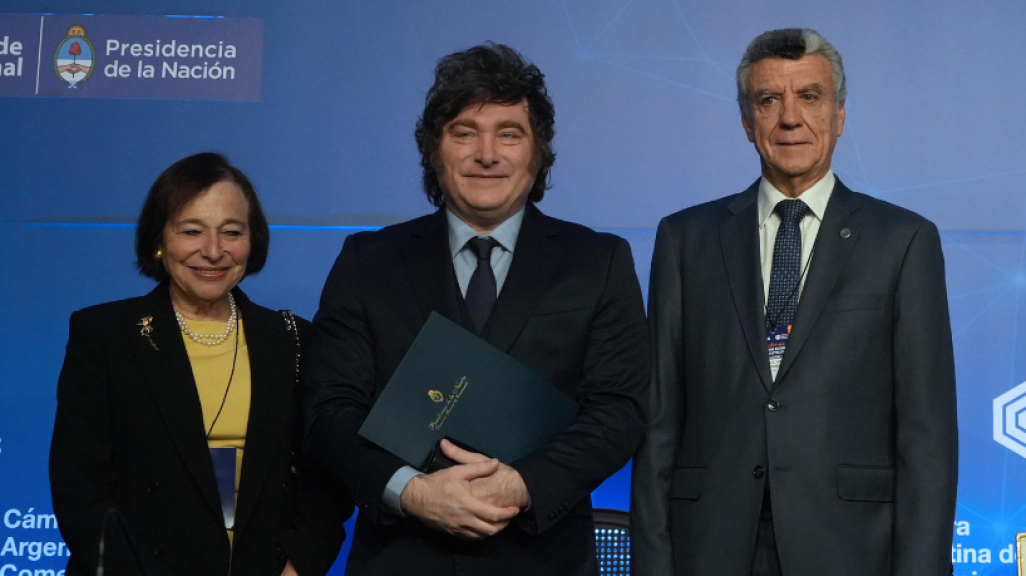
(L-R) AS/COA's Susan Segal, Argentine President Javier Milei, and CAC's Natalio Mario Grinman

(L-R) AS/COA's Susan Segal, Argentine President Javier Milei, and CAC's Natalio Mario Grinman. (Photo: Capece/Lasansky)

Conference Summary and Videos: Argentina’s Economic and Political Outlook

COA's annual conference in Buenos Aires featured President Javier Milei, cabinet members, governors, and private-sector leaders.

Council of the Americas' annual conference in Argentina is the premier forum bringing together the government officials, business leaders, and investors shaping the country's development. Held in partnership with the Chamber of Commerce and Services of Argentina, this year’s event featured remarks by President Javier Milei, senior-level officials, and business leaders.

Speakers:

  • Javier Milei, President of Argentina
  • Diego Santilli, Chief of the Cabinet of Ministers of Argentina
  • Pablo Quirno, Minister of Foreign Affairs, International Trade and Worship of Argentina
  • Federico Sturzenegger, Minister of Deregulation and State Transformation of Argentina 
  • Jorge Macri, Mayor of the City of Buenos Aires 
  • José Luis Daza, Deputy Minister of the Economy of Argentina
  • Rolando Figueroa, Governor of the Province of Neuquén, Argentina
  • Carlos Sadir, Governor of the Province of Jujuy, Argentina
  • Gustavo Sáenz, Governor of the Province of Salta, Argentina
  • Ignacio Torres, Governor of the Province of Chubut, Argentina
  • Hugo Eurnekian, President and CEO, Compañía General de Combustibles SA (CGC)
  • Rodolfo Freyre, CEO, Southern Energy LNG
  • Luciano Laspina, Executive Director, CIPPEC
  • Florencia Lendoiro, Deputy Editor, Bloomberg Línea
  • Martín Pérez de Solay, CEO, Glencore Argentina 
  • Maria Eugenia Sampalione, Executive Director & Country Manager, Newmont Argentina
  • Natalio Mario Grinman, President, Chamber of Commerce and Services of Argentina (CAC)
  • Susan Segal, President and CEO, Americas Society/Council of the Americas
Welcome remarks

"I have never seen such an interesting convergence between what the world needs and what Latin America has to offer,” said Susan Segal of AS/COA kicking off the 2026 COA Conference: Argentina. To open the event, Segal and Natalio Mario Grinman of CAC offered complementary perspectives on Argentina’s economic transformation.

Grinman argued that reducing the role of the state is restoring the private sector’s central role in the economy, while requiring businesses and individuals to assume greater risk and responsibility. He acknowledged the economic transformation’s social costs, including company closures and job losses, but argued that staying the course is necessary to build a more predictable country. His central message: “When the private sector regains prominence, it must also assume a greater share of responsibility.”

Segal placed Argentina’s current economic moment within the context of a broader Latin American opportunity driven by energy, critical minerals, food, and technology. However, just 14 percent of regional exports remain within Latin America and the Caribbean, while the region represents only six percent of global trade. Capturing the opportunity, she argued, requires macroeconomic stability, clear rules, legal certainty, investment, and regional integration.

Jorge Macri, Mayor of the City of Buenos Aires

Jorge Macri, the Buenos Aires mayor, outlined order, economic freedom, and private-sector confidence as the foundations forthe city’s growth and for Argentina’s broader economic recovery. He spoke about his efforts aligning the city government with the national administration’s emphasis on macroeconomic stability, lower inflation, market opening, deregulation, and fiscal discipline, arguing that these policies are necessary to attract investment and reverse years of economic decline. “Only where there is order is there progress,” he said.

Macri presented Buenos Aires as both a major contributor to the national economy and a test case for pro-market governance. He noted that the city accounts for 21 percent of Argentina’s GDP and highlighted fiscal and administrative efficiency measures, including the elimination of more than 8,900 administrative positions and 359 management posts. Still, he’s maintainedpublic investment at around 19 percent of the city budget.

The mayor also emphasized property rights and law enforcement as economic-policy tools, citing 931 properties returned to owners, representing about $500 million in assets and potentially more than $2 billion in future development.

Diego Santilli, Chief of the Cabinet of Ministers of Argentina

In his remarks, Diego Santilli described macroeconomic and institutional order, together with greater international openness, as the foundation for attracting investment, increasing exports, and sustaining long-term growth.

Santilli argued that fiscal stability is essential to restore predictability and enable private-sector growth. “Fiscal balance is non-negotiable because it is a necessary condition to end inflation, restore credit, and allow the economy to grow again,” he said.

As evidence of Argentina’s potential, he cited an energy surplus of nearly $10 billion over the past 12 months, record mining exports of $9.6 billion, and knowledge-economy exports of $9.7 billion. He also pointed to 44 projects representing more than $150 billion in prospective investment and 130,000 jobs.

José Luis Daza, Deputy Minister of the Economy

“Argentina has already changed,” said Argentine Deputy Minister of the Economy José Luis Daza spoke on President Javier Milei’s goal of a smaller state, a stronger fiscal balance, and a more open economy, coupled with a commitment to the rule of law and respect for contracts.

In his remarks, Daza highlighted the fiscal surplus, disinflation, and a shift from short-term financing toward direct investment as evidence of greater stability and credibility. He also offered a vision of a major transformation of Argentina’s productive base, led by the energy, mining, and agriculture sectors.

“I’m not optimistic about Argentina; I’m realistic,” he said, grounding his growth outlook in harnessing the country’s natural resources and human capital. Sustaining that trajectory, he argued, will require clear rules and legal certainty. Daza acknowledged that poverty and middle class vulnerability remain significant challenges.

Mining: Investment, Development, and Opportunity in Argentina

Panelists:

  • Carlos Sadir, Governor of the Province of Jujuy
  • Gustavo Sáenz, Governor of the Province of Salta
  • Martín Pérez de Solay, CEO, Glencore Argentina
  • Maria Eugenia Sampalione, Executive Director & Country Manager, Newmont Argentina
  • Moderador: Luciano Laspina, Director Ejecutivo, CIPPEC

This panel of governors and private-sector leaders explored the sector as offering a historic economic opportunity for Argentina, driven by global demand for critical minerals. Moderator Luciano Laspina of CIPPEC noted that Argentina is home to 12 of the 17 strategic critical minerals identified by the EU, but provincial and industry leaders stressed that predictable rules and legal certainty are essential to convert geological potential into long-term capital.

Salta Governor Gustavo Sáenz said: "The world is also watching us, looking at us, and we need to build trust.” He said the province of Salta already has approximately $5 billion in mining investment underway, with projects potentially reaching $12 billion.
Private-sector executives reinforced that mining projects require decades of regulatory predictability. As for Jujuy, Governor Carlos Sadir highlighted that the province produces 60 percent of the lithium Argentina exports but stressed that the sector requires "much more investment" in energy and road infrastructure.

María Eugenia Sampalione of Newmont highlighted an $800 million investment to extend Cerro Negro’s mine life and create additional employment, while Martín Pérez de Solay from Glencore identified seven world-class projects currently advancing through development stages. Pérez de Solay argued that Argentina could potentially supply between 1.5 million and 2 million tons of copper over the next decade, underscoring the scale of the opportunity if permitting, infrastructure, and investment conditions improve.

Energy: Investment, Development, and Opportunity in Argentina

Panelists:

  • Rolando Figueroa, Governor of the Province of Neuquén
  • Ignacio Torres, Governor of the Province of Chubut
  • Hugo Eurnekian, President and CEO, CGC
  • Rodolfo Freyre, CEO, Southern Energy LNG
  • Florencia Lendoiro, Deputy Editor, Bloomberg Línea (moderator)

This panel of governors and private-sector leaders discussed how Argentina can transform its abundant energy resources into exports, investment, and development.

One focus was Vaca Muerta, a major shale formation in Argentina. Governor of Neuquén Rolando Figueroa explained that “Vaca Muerta is a rock 3,000 meters underground” and not an automatic source of wealth. The province is building 1,000 kilometers of roads and receiving roughly 70 new residents per day to develop it, creating growing demands for infrastructure and social sustainability.

From the private sector, CGC’s Hugo Eurnekian described “an enormous revolution” in the industry, driven by new operators and infrastructure initiatives spearheaded by the private sector

But Chubut Governor Ignacio Torres emphasized that energy revenues should translate into improvements in infrastructure and quality of life. "The foreign currency generated must necessarily go hand in hand with better infrastructure," he said.

Federico Sturzenegger, Minister of Deregulation and State Transformation

“It is the first time in our adult lives that Argentina is experiencing a growth process led by exports,” said the Federico Sturzenegger. He highlighted that Argentina is entering a cycle of "unprecedented growth" underpinned by macroeconomic stability and a long-term agenda focused on structural reforms.

Sturzenegger noted that the economy grew 7.5 percent between the start of President Javier Milei's term in December 2023 and May 2026. He added that, based on market expectations, accumulated growth over the course of Milei's presidency could reach 13 percent.

Zooming in on the government's work this year, the minister highlighted 12 reforms implemented or underway in 2026—including labor, mining, capital-market, and infrastructure measures—and identified property rights, financing, infrastructure, and economic openness as priorities for sustaining growth. He also noted that the government continues to work on a trade and investment agreement with the United States.

Pablo Quirno, Minister of Foreign Affairs, International Trade, and Worship

Foreign Affairs Minister Pablo Quirno outlined a foreign policy focused on expanding Argentina’s economic integration and positioning the country as a strategic partner in a world competing for energy, critical minerals, food, and technology. “Argentina is thinking big again,” he said.

Quirno described the ministry as a “strategic multiplier” of the government’s economic reforms, tasked with translating domestic stability into trade and investment. He highlighted agreements and negotiations with Asia-Pacific, the European Union, and the United States, noting that Argentina’s trade network has expanded from covering roughly 10 percent of global GDP to nearly 30 percent. The goal is to approach 80 percent.

Amid growing concerns about supply-chain security, Quirno argued that Argentina can become “one of the pillars of global economic security.” Quirno concluded with a long-term view of sustaining the country’s transformation: “Our responsibility is to rise to the challenge of the country we can build, because the great Argentina of the future takes shape in the decisions we make today.”

Javier Milei, President of Argentina

“My mandate was to lower inflation and grow the economy, and I'm going to accomplish that," said President Javier Milei. The president, who gave closing remarks at the event, outlined his growth model as a combination of fiscal stability, deregulation, trade openness, and technological progress under a framework that defends individual freedoms and private property.

“Faced with intellectual shallowness, ignorance, and bad faith, the first response, in the best tradition of Milton Friedman, is: data first,” said the president before detailing the macroeconomic achievements of his first two and a half years in office. He highlighted an 85 percent reduction in inflation and a drop in the debt-to-GDP ratio from 100 percent to 40 percent, excluding intra-public-sector liabilities. Milei also signalled that the economy had grown 10 percentage points and the rate of poverty had fallen from 20 percent to 6 percent.

Looking ahead, Milei argued that sustained investment in human capital, increased stimulus for savings, and trade openness could convert Argentina into a developed country within 20 years. “The battle is not economic; the battle is moral,” he said, arguing that “fair” policies produce efficiency, progress, and well-being.

Related

Explore