Brian Winter on CNN about U.S. Strategy in Latin America After Maduro's Capture
Brian Winter on CNN about U.S. Strategy in Latin America After Maduro's Capture
"Many countries are asking themselves if the United States of the early twentieth century is essentially back," said AS/COA's vice president.
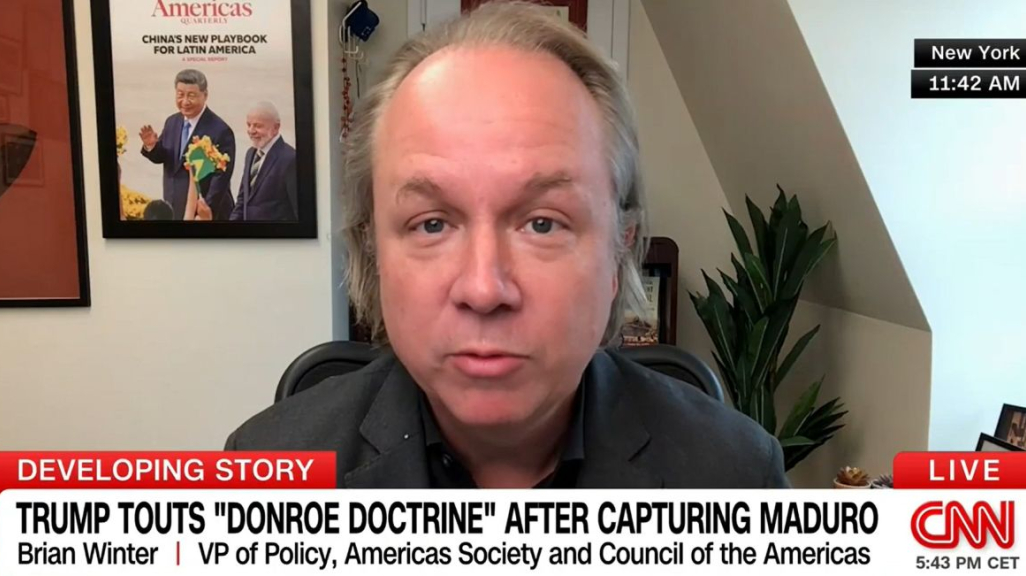
Brian Winter, editor-in-chief of Americas Quarterly and vice president of policy at Americas Society/Council of the Americas, spoke with CNN anchor Zain Asher about the U.S. administration policy of seeking a stronger influence over the Western Hemisphere.
Asher asked about how the capture of Nicolás Maduro capture in Venezuela differs from U.S. policies of dominance in the region over the years, like the overthrow of government leaders in countries like Guatemala in 1954, Chile in the 1970s, and Panama in the late 1980s.
"There is nothing exceptional about what President Trump did in Venezuela if you look at the long arc of American history," said Winter. "Some are the examples that you cited, but if you go back to the gunboat diplomacy of the 1900s and 1910s, Teddy Roosevelt was carrying a big stick in the region. These kinds of actions have been what the United States does in its own hemisphere. The exception really seems to have been the last 35 years or so since the end of the Cold War, when the threat, which at the time was the Soviets, receded."
Winter was also asked about the consequences of U.S. actions in Venezuela for countries like Russia or China, which could feel emboldened when it comes to Ukraine or Taiwan, respectfully.
"Well, this is the question that countries all over the world are asking themselves right now, like longtime allies in places like Europe, and also other powers, including Russia and China and certainly countries elsewhere in Latin America, who are asking themselves if the United States of the early 20th century is essentially back," said Winter.