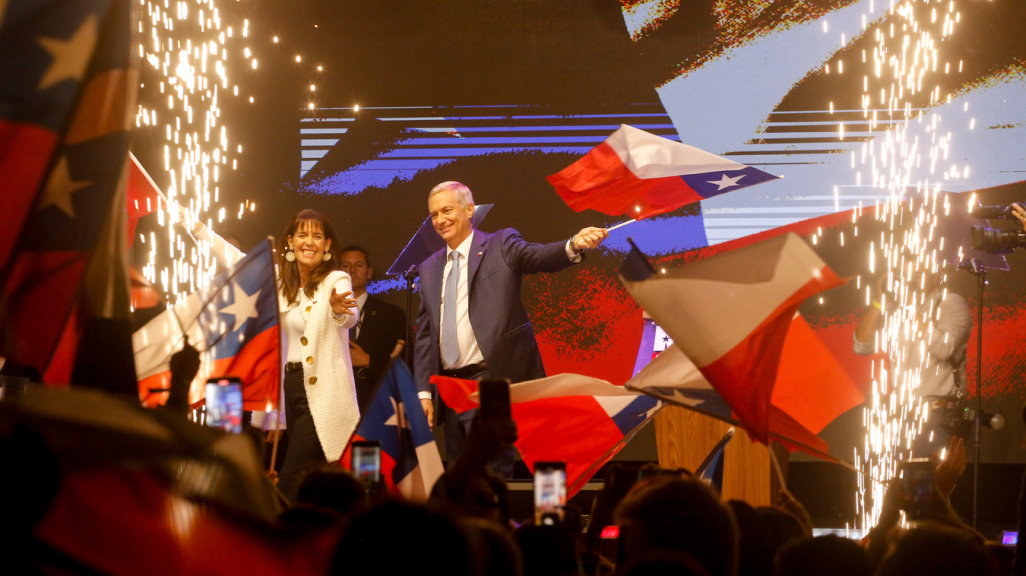
José Antonio Kast (C) at his victory rally. (AP)

Chilean President-elect José Antonio Kast (C) at his victory rally. (AP)

Share

AS/COA Insider: Susan Segal on José Antonio Kast's Presidential Victory in Chile

"Kast gave a unifying acceptance speech that stressed rule of law and democratic values," said AS/COA’s CEO and president.
Image
Susan Segal

On December 14, José Antonio Kast won a decisive victory in the second round of Chile’s presidential election, avenging his loss in the 2021 runoff. Kast, a right-wing former congressman, centered his campaign on addressing security and migration concerns

“I've been working with Latin America for 50 years and this is the first time that I can remember this level of commonality among democratically elected countries,” said Susan Segal, president and CEO of AS/COA. She discusses Kast’s agenda, his victory speech, and what his election means for Chile’s relationship with Washington, Beijing, and the rest of Latin America.


AS/COA Online: Kast got 58 percent of the vote in last night's election, a double-digit margin ahead of his opponent, Jeannette Jara. What are some of the major factors you credit with why voters responded to his message?

Susan Segal: I think Chileans responded positively to Kast because he talked about the issues that voters care about: security and immigration. They were the hallmark of his campaign. People want improved security. They don't want to be robbed. They don't want to be afraid to stop at a traffic light.

He also spoke about going back to basics with the economy, and I think people also relate to that. Just like everwhere else, Chileans are concerned about growth.

AS/COA Online: What did you make of last night’s proceedings?

Segal: Yesterday was an important day for Chile. As soon as Jara saw Kast surpass 50 percent, she called him and congratulated him. President Gabriel Boric congratulated him and has already set the tone for the transition. It showed civility and respect.

Then, Kast gave a unifying acceptance speech that stressed rule of law and democratic values. It showed that, as president, he understands that he is going to have to negotiate with Congress to get his agenda through.

I'm really excited because what's happening is you're seeing a real respect for democracy, for democratic values, for civility, and for consensus building. There aren't many places where that actually happens today, particularly when a leader wins such a decisive victory.
AS/COA Online: The Chilean peso rallied after last night's result. What are investors going to be looking for from Kast?

Segal: One of the things that investors talk about in Chile is how complicated it is to get needed permits to make an investment. And Kast, I think, is committed to simplifying that process.

The reason that’s important is that Chile today has competition from countries like Argentina and perhaps even Bolivia. Chile is obviously an investment grade country, and it’s considered less risky than competitors, but sometimes investors look at where they can do the same thing for less. As the Argentines like to say, there's lots of copper on Chile’s side of the Andes, but there's also lots of copper on our side of the Andes. I think that one of the things that investors will look to is whether he will simplify everything and make it easier to invest.

AS/COA Online: Kast has made no secret that he is an admirer of President Donald Trump. What are you expecting to see from the U.S.-Chilean trade relationship?

Segal: Chile and the United States have had a very special trade relationship for a long time, and a lot of what the United States imports from Chile is countercyclical: fruits, vegetables, things that don’t grow in the United States in the middle of winter but do grow in Chile in their summer. I think that, overall, the trade relationship, to the extent that it can, will get stronger.

Chile's largest trading partner today is China. The United States isn't going to be able to supersede that. But Chile's largest investment partner is still the United States, and that's true of many countries in Latin America.

There are activities, like the management of telescopes and the strategic patrolling of the South Pacific, where I would expect the partnership between the United States and Chile to get a lot stronger.

AS/COA Online: What does Kast’s election mean for Chile’s regional position?

Segal: Chile has now elected a president on the right that fits in with several other presidents around the hemisphere. We have President Javier Milei in Argentina, President Rodrigo Paz in Bolivia, and President Daniel Noboa in Ecuador. There are going to be a new elections in countries such as Colombia and Peru next year.

I've been working with Latin America for 50 years and this is the first time that I can remember this level of commonality among democratically elected countries. The opportunity is that this group of Latin American countries will be able to potentially work on really important issues together, like security. You cannot approach security as just one country. Criminal groups are multinational, and these presidents will have the opportunity for more unified action.

What else is this going to give them the opportunity to do? Trade. Commerce between Latin American countries is low, so this may be an opportunity for more regional trade and harmonization.

This interview has been edited lightly for clarity and length.

Related

Explore