Americas Society
Council of the Americas
Uniting opinion leaders to exchange ideas and create solutions to the challenges of the Americas today
Guide: Colombia’s Peace Talks
Tabs

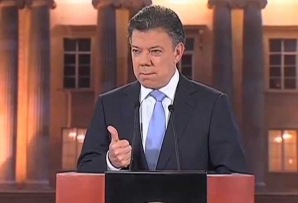
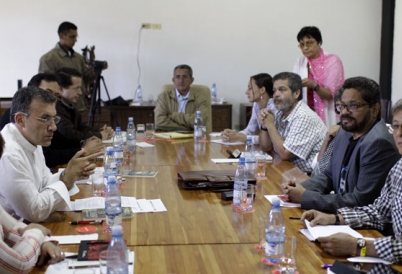
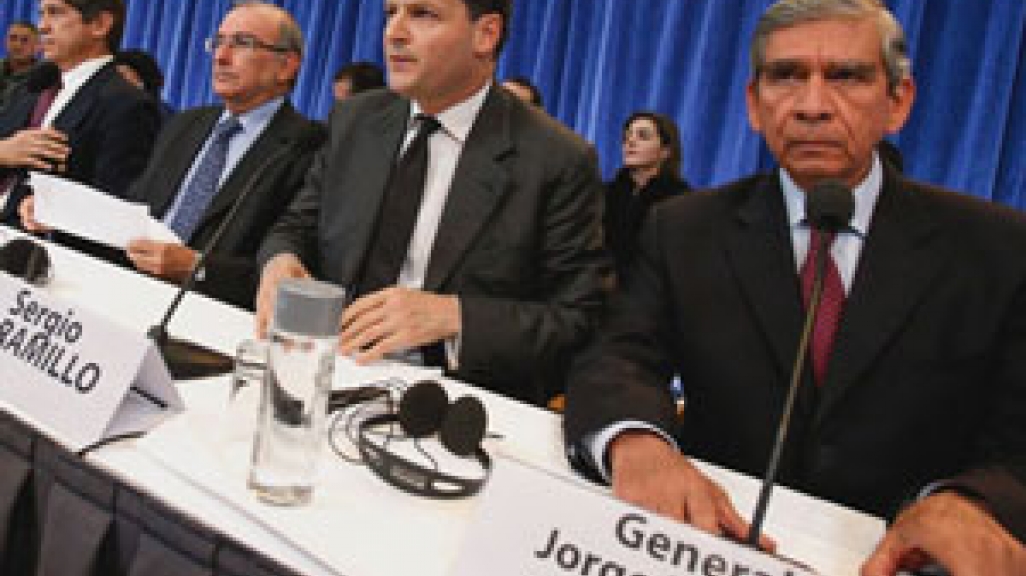
Updated May 28, 2013—On August 27, Colombian President Juan Manuel Santos signed a preliminary agreement in Havana, Cuba to begin peace talks with the guerrilla group Revolutionary Armed Forces of Colombia, known more commonly as the FARC. Santos confirmed the start of peace talks with the country’s largest rebel group, adding that negotiations could include the National Liberation Army, or ELN, the country’s second largest guerrilla faction. In an effort to bring an end to the nearly half-century-long conflict, the government’s efforts came after the passage of a Legal Framework for Peace—a bill passed by Colombia’s Congress and sanctioned by Santos in June. The peace talks also follow the deaths of top FARC leaders, including Mono Jojoy in 2010 and Alfonso Cano last year.
In an effort to deliver the latest on the peace talks, AS/COA Online offers a collection of links to primary sources, news coverage, and multimedia content.
Image: AP Photo. Rachel Glickhouse and Mark Keller contributed to this guide, originally published on August 28, 2012.
The Latest
In a joint statement on May 26, negotiators said that they reached an agreement on land reform.
On January 20, the FARC announced its unilateral two-month ceasefire would not be extended. A government ceasefire still remained off the table, negotiator Humberto de la Calle said on January 24.
During the talks in January, both sides discussed the proposals on agrarian reform that emerged during the December public forum in Bogota.
A public forum on agricultural reform took place in Bogota from December 17 to 19.
On December 2, Santos set a deadline for the end of the talks: November 2013.
As the first round of negotiations in Havana came to an end on November 19, the government announced the launch of a website for citizens to contribute to discussions on the peace talks.
For more information on key dates during the peace process, visit our timeline.
Primary Sources
- Read Colombian President Juan Manuel Santos’ August 27 announcement of the peace talks.
- Access the agreement released September 4, called the General Agreement for the End of the Conflict.
- Read Santos' September 4 speech discussing the new agreement.
- Access the webpage of Colombia’s Military Forces.
- Colombia's RCN Radio obtained a copy of the agreement text outlining the process for "direct and uninterrupted talks."
- Visit the Revolutionary Armed Forces of Colombia’s (FARC) official webpages.
- Visit the official webpage of the National Liberation Army (ELN). ELN leader Nicolás Rodríguez declared his group’s openness to negotiations with the government in an exclusive interview with Reuters.
- The Colombian Congress passed the Legal Framework for Peace in June 2012. Access a PDF of the text.
- Reporter Jorge Enrique Botero of teleSUR broke news of the announcement during the evening of August 27.
Timelines: Current & Past Peace Processes
Major milestones in the current round of peace talks:
- August 27: Colombian President Juan Manuel Santos signed a preliminary agreement in Havana, Cuba to begin peace talks with the guerrilla group Revolutionary Armed Forces of Colombia.
- August 28: Authorities arrested seven people accused of attempting to kill former Interior Minister Fernando Londoño in May; police say the suspects may have been hired by the FARC.
- September 4: Santos and FARC leaders announced they had signed an agreement to begin the peace process.
- October 18: Negotiators from the Colombian government and the FARC held a press conference in Norway to mark the start of the process.
- October 22: The Colombian government lifted 191 arrest warrants in order for 29 FARC negotiators to participate in the talks. Attorney General Eduardo Montealegre explained that the suspensions were only valid in Norway and Cuba, where negotiations will take place. "If one of the 29 FARC members goes to a place unauthorized by the government or peace commissioner, arrest orders will be made," he said.
- November 6: After initial dialogues in Oslo, representatives from both sides moved to Havana to discuss logistics ahead of the official start to talks.
- November 12: In a letter, the National Liberation Army (ELN) expressed a desire to begin exploratory talks to potentially join the peace process.
- November 19: Talks got underway officially in Havana, Cuba. As the talks began, FARC announced a two-month unilateral ceasefire.
- November 25: Negotiators announced a public forum on agrarian reform to be held in Bogota in December.
- November 29: The first round of Havana talks ended. The government announced the launch of a website for citizens to contribute to discussions on the peace talks.
- December 2: Santos set a November 2013 deadline for the end of the talks.
- December 19: The three-day public forum on agricultural reform concluded in Bogota.
- January 14: During the January round of talks, both sides discussed the proposals on agrarian reform that emerged during the December public forum in Bogota.
- January 20: The FARC announced its unilateral two-month ceasefire would not be extended.
- January 24: A government ceasefire still remained off the table, negotiator Humberto de la Calle said.
- May 26: In a joint statement, negotiators said that they reached an agreement on land reform.
This is not the first time the Colombian government will attempt negotiations with the FARC. In the past 30 years, nearly every Colombian leader attempted negotiations in some way. The most extensive of these was undertaken by President Andrés Pastrana from 1999 to 2002 in the so-called Caguan Peace Talks. In preparation for those talks, Pastrana called a ceasefire with the FARC and agreed to demilitarize a 42,000 square mile area of the country. However, the FARC refused to cooperate and instead used the demilitarized zone as a training ground for new fighters, redoubling its drug trafficking operations. Pastrana called off the talks with the FARC in 2002. No talks were held under his successor, Álvaro Uribe (2002-2010).
A number of Colombian and international press outlets feature timelines of the FARC’s history, conflict with the Colombian state, and the failed Caguan negotiations.
- Colombia’s El Tiempo reports on peace attempts made by past Colombian presidents, beginning with Belisario Betancur Cuartas (1982-1986). The Colombia daily also offers an infographic of past peace talks, beginning with FARC negotiations in 1982 to the Pastrana administration talks that ended in 2002.
- Colombia’s Terra provides a timeline of the FARC’s history since its 1964 founding.
- Spain’s RTVE and El Mundo detail the largest happenings in the battle between the FARC and the Colombian state over the past 15 years.
- The New York Times provides a timeline of the conflict dating back to the 1964 establishment of the FARC and accompanied by highlights of its news coverage.
Domestic Reactions
- Santos announced the proposed peace talks, saying the goal of the process was to bring an end to the conflict, rather than prolong it. He also assured that security forces would continue to operate in “every centimeter” of the country. Watch the video below.
- Colombia’s Attorney General Eduardo Montealegre said he supports Santos and that “the new legal framework for peace…provides huge instruments for the president to sit down to negotiate.” He added: “I prefer to have Timochenko and Ivan Marquez serving in Congress rather than sowing terror throughout the country.”
- Former President Álvaro Uribe criticized the proposed peace talks, saying they would serve to help reelect Venezuelan President Hugo Chávez; Uribe claimed Chávez would take credit for helping with the negotiations. Prior to the announcement, Uribe wrote on Twitter that “in a democracy, negotiating with terrorists isn’t a policy, but rather subjecting [them] to justice.”
- Former Interior Minister Fernando Londoño said a negotiation means “starting from scratch” after failed negotiations, and that the talks would end unsuccessfully.
- According to a National Consulting Center survey released last week, 74 percent of Colombians support peace talks.
- A study by Colombia’s Fundación Ideas para la Paz conducted earlier this year found that the majority of a group of the country’s business leaders favor negotiations with rebel groups.
- Former Armed Forces Commander General Harold Bedoya said the conditions aren’t right for a peace process, and that Santos wants to start talks due to a recent decrease in his popularity ratings.
- Former President Andrés Pastrana spoke in favor of the initiative, saying it was “a necessity felt by the country.” He added that the international community would be fundamental in supporting the process, and by following international law, the process could be “viable and valid.”
- Former President Belisario Betancur said he was optimistic about the peace process. But he cautioned: "Before the [former] guerrillas can give speeches in Congress, peace will have to have come."
Watch President Santos’ declaration of the peace process:
International Reactions
- Reuters reported that U.S. President Barack Obama knows about the negotiations and “is in agreement.”
- A September 4 release from the White House Press Secretary explained that Obama welcomed the negotiations. "The Santos administration has demonstrated an unwavering commitment to seeking a durable peace and ensuring a better life for all Colombians through its security and social inclusion policies,” Obama said.
- As of August 28, the Norwegian Ministry of Foreign Affairs would not confirm or deny the Scandinavian country’s involvement in peace talks, reported EFE.
- In an August 28 statement, Vice President of the European Commission Catherine Ashton said she “warmly welcomed” the peace talks, and expressed hope that the negotiations would mark “the beginning of the end” of Colombia’s conflict.
- José Miguel Insulza, secretary general of the Organization of American States (OAS) released a statement on August 28 welcoming the peace talks, offering support from the organization in the Colombian government’s efforts.
- U.S. State Department Spokesperson Victoria Nuland said in an August 28 press briefing that the United States would “welcome any efforts to end the hemisphere’s longest-running conflict and to bring about lasting peace in Colombia.”
- Spokespeople for UN Secretary General Ban Ki-moon said he was “very pleased” with the declaration, and offered to act as a moderator should the two parties consider it appropriate.
- UK Ambassador in Colombia John Dew expressed his country’s support in an interview with Colombia’s RCN Radio, saying “anything that helps to achieve peace in Colombia is welcome.”
- In an interview with Ecuador’s Gama TV, Ecuadoran President Rafael Correa said “it’s now or never” for the FARC to reach a peace with the Colombian state, and that he hoped the negotiations would end happily.
- Venezuelan President Hugo Chávez said his country would be willing to help Colombia with the peace process, though he did not specify how.
- In a statement, Brazilian President Dilma Rousseff wrote that she celebrates the peace process. "I'm sure that the actors involved in the peace process and national reconciliation will have the political vision and the social sensibility to put the great country of Colombia first," she said.
Online Analysis & Social Media
Explore coverage of the peace talks.
- Semana outlines ten key points about the talks, explaining the five main discussion points, the main negotiators from both sides, the three phases of the process, and an estimated timeline, among other issues. The article also says that the ELN will not participate in the talks for the time being. An October 17 analysis in the magazine looks at differences between the 2012 peace process and previous talks. "The weakness of the guerrillas is a reality, but it's relative because they still have the possbility to do damange in political life, control certain regions, and continue guerrilla warfare," it says.
- Colombia's La Silla Vacia has a matrix showing the similarities of the peace process to other successful peace talks in other regions of the world such as El Salvador, Guatemala, and Angola. It includes factors such as duration of the conflict, guarantors from other countries, and a ceasefire.
- Earlier, Semana looked at the government’s legal strategy to initiate peace talks, giving a detailed overview of four recent laws and two proposed constitutional reforms. The article shows how legislation like the Law of Public Order and the Law for the Demobilized gives the government a legal framework for negotiations with the FARC.
- La Silla Vacilla’s online debate forum offers experts and officials’ perspectives on the timing for the peace talks. While some say it’s the right time—such as the director of Colombia’s Ethnic, Social, and Political Thought Institute—others are less certain. Antanas Mockus, former Bogota mayor and presidential candidate expressed concern that it may not be the right time to negotiate, and writes that “the president and FARC have an enormous responsibility to not create false hopes again.”
- In addition, La Silla Vacia examines eight key factors for successful peace talks, including government credibility, investment, the weakening of the FARC, and the legal framework. In evaluating Santos’ ability to move ahead with talks, the article explains the president has many advantages, including a congressional majority, good relations with the media and business elite, and international credibility.
- InSight Crime explores how peace talks could impact violence and drug trafficking in Colombia. One of the biggest variables, the article says, is how many guerrillas will actually participate in talks and the possibility of a split within the FARC’s hierarchy.
- El Tiempo’s CityTV features a video with two opposing views on peace talks, with political analyst Alejo Vargas defending negotiations and former General Harold Bedoya speaking against talks. Vargas says: “The biggest risk is that the guerrillas aren’t convinced that the time has come to end the war.”
- Follow President Juan Manuel Santos and Former President Álvaro Uribe on Twitter. The FARC also occasionally use Twitter to communicate.
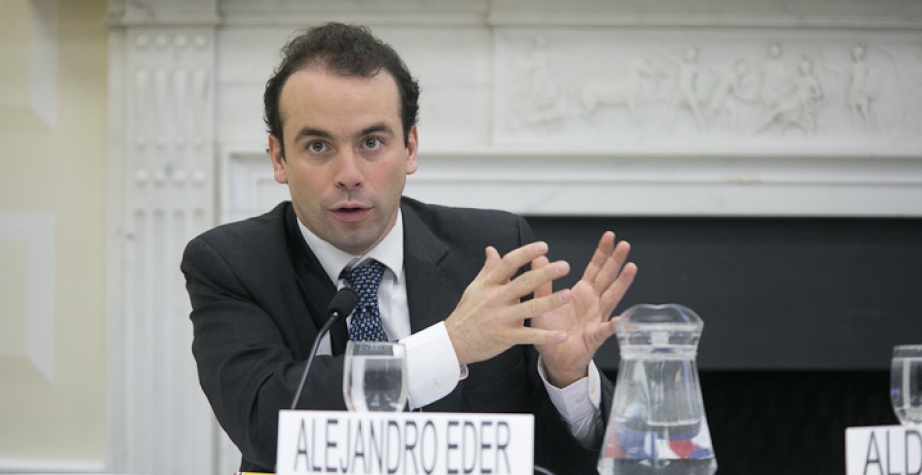
Audio: Director of the Colombian Agency for Reintegration Alejandro Eder
Tuesday, January 29, 2013
AS/COA hosted a conversation with Alejandro Eder, who discussed Colombia's peacebuilding and reintegration experience....
Colombia's Peace Talks Begin in Oslo
October 18, 2012
Watch the beginning of the press conference that began Colombia's peace talks in Oslo, Norway on October 18....
Video: Gold Insigne Award Dinner: President of Colombia Juan Manuel Santos
September 26, 2012
Americas Society presented President Juan Manuel Santos with the Gold Insigne, the organization’s highest honor, in recognition of his extraordinary cultural, economic and political accomplishments as president of Colombia....
Colombia's President Announces Peace Talks
August 28, 2012
On August 27, President Juan Manuel Santos delivered an address to announce the start of peace talks with Colombia's largest guerrilla group....
FARC Political Participation up for Debate during Colombia Peace Talks
Thursday, March 7, 2013 | Rachel Glickhouse
Summary: A Discussion with Alejandro Eder, Director of Colombia’s Agency for Reintegration
Thursday, January 31, 2013 | Kailie Middleton
Colombia Peace Talks Move to Cuba amid Calls to Widen Participation
Thursday, November 8, 2012 | Rachel Glickhouse
Colombia’s Peace Process Set to Begin in Oslo
Friday, October 12, 2012 | Rachel Glickhouse
Colombia's Santos wants peace with FARC by 2013
Thursday, September 27, 2012 | Reuters
Colombia's Juan Manuel Santos Hypes Success At Council of the Americas
Thursday, September 27, 2012 | Fox News Latino
Colombia names team for peace talks with FARC rebels
Wednesday, September 5, 2012 | Thomson Reuters
Colombia to begin peace talks with the FARC, but no cease-fire
Wednesday, September 5, 2012 | The Christian Science Monitor
O interesse dos mediadores em um pacto histórico
Wednesday, September 5, 2012 | Eric Farnsworth | O Estado de São Paulo
Comunidad internacional resalta el anuncio del presidente Juan Manuel Santos
Tuesday, August 28, 2012 | El Tiempo
In Cuba, Colombia’s Santos Assumes Regional Mediator Role
Thursday, March 8, 2012 | Rachel Glickhouse
Colombia Forges Ahead with Restitution Process as Victims Law Goes into Effect
Tuesday, February 14, 2012 | Rachel Glickhouse
The FARC’s New Boss
Thursday, December 1, 2011 | AQ Web Exclusive
Santos Holds the Line Against the FARC—and Wins
Sunday, November 6, 2011 | Christopher Sabatini and Ryan Berger | CNN Global Public Square
Colombia Takes out Top FARC Leader Alfonso Cano
Saturday, November 5, 2011 | Carin Zissis
Video & Transcript: Public Lunch - Juan Manuel Santos, President of Colombia
Thursday, September 22, 2011 |